Physical Address
Victory Est, Ogombo Ajah, Eti-Osa, Lekki 101245, Lagos
Physical Address
Victory Est, Ogombo Ajah, Eti-Osa, Lekki 101245, Lagos
Nigeria Financial News, Stock Market Data, Economy & Market Analysis
Nigeria Financial News, Stock Market Data, Economy & Market Analysis
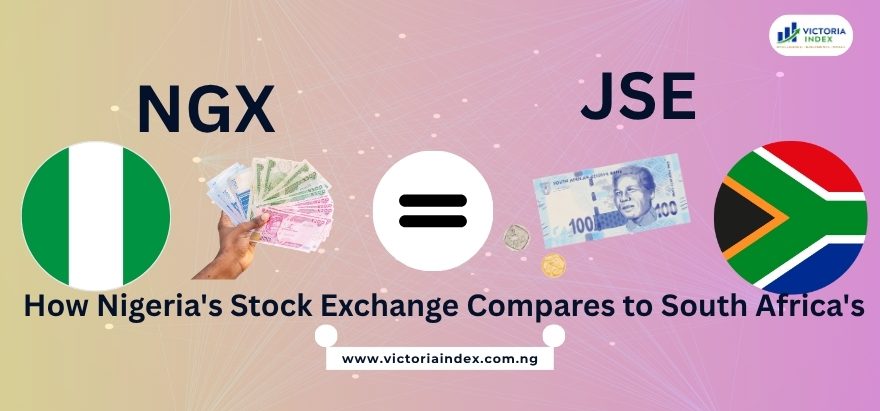
NGX is having its best year in decades, but JSE is still 13 times bigger. Here's how Africa's two top exchanges really compare.
Nigeria and South Africa boast Africa’s largest economies and their stock exchanges are typically the two to spring to mind when the words ‘African equities’ are invoked globally. In reality, however, the Nigeria Stock Exchange (NGX) and Johannesburg Stock Exchange (JSE) are worlds apart. The former is a dynamic, externally influenced equity market in the midst of a record boom, while the latter is an established, internationally integrated behemoth that outshines all others in Africa. Read on as we take an in-depth comparison between these two exchanges and consider the implication of this disparity for Nigerian investment portfolio decisions.
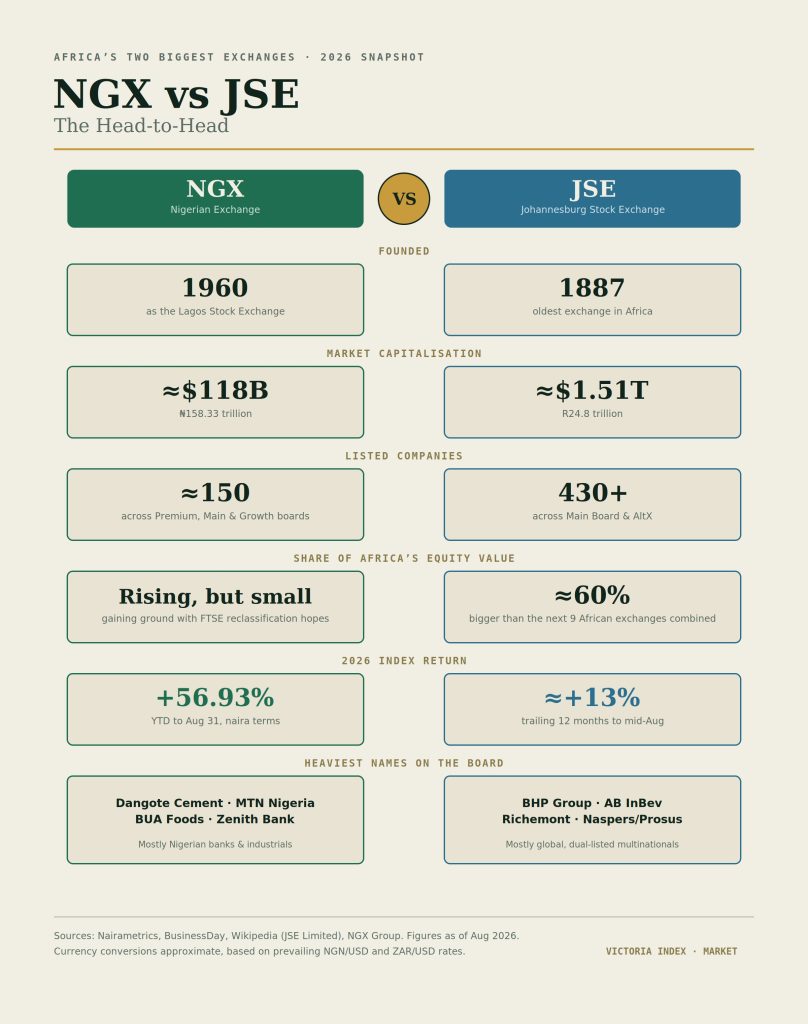
Start with the raw numbers – they define the rest of everything. Africa’s oldest and biggest bourse, established in 1887, the JSE has an existing market capitalisation of approximately R24.8 trillion, or about $1.51 trillion – a figure that accounts for about 60% of the value of all listed companies across the African continent. If we consider the markets themselves, the JSE is larger than the next nine African exchanges put together.
The NGX, meanwhile, closed the month in July with a market cap of approximately 158.33 trillion, or roughly $118 billion based on the present exchange rates.
The JSE is worth approximately 13 times the value of NGX. It also lists more than 430 companies between its Main Board and its AltX growth board compared with roughly 146 to 151 listed on the NGX, split across their Premium, Main and Growth boards. Nigeria’s exchange, meanwhile, is much younger in its current iteration – dating back to the Lagos Stock Exchange, set up in 1960 before it renamed itself the Nigerian Exchange Group after its 2021 demutualisation.
For a broader look at which individual Nigerian names are driving activity on the NGX side of that comparison, see our earlier roundup of Nigerian stocks to watch in 2026 and our feature on the best banking stocks to buy during the recapitalization era, since banking names are central to the NGX story this year.
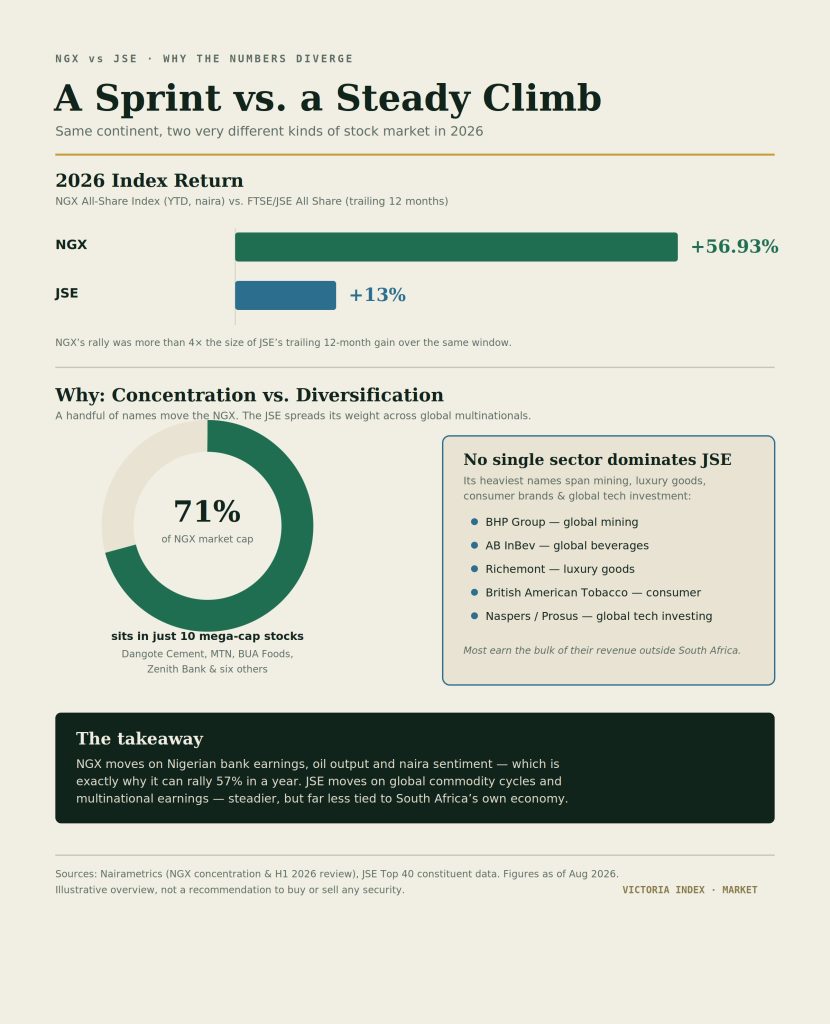
This is where the comparison gets genuinely interesting, because on pure returns, tiny NGX has been outrunning giant JSE by a wide margin in 2026. According to Nairametrics’ mid-year review of Africa’s major exchanges, the NGX All-Share Index had returned 47.43% by the end of June, nearly double the average return across the six major African markets reviewed. By the end of August, that figure had climbed to a 56.93% year-to-date gain in naira terms, and, more strikingly, BusinessDay reported Nigeria briefly led the entire continent in dollar terms, with a 69.5% USD return before Zimbabwe’s exchange overtook it in the final week of July.
The JSE’s FTSE/JSE All-Share Index, by contrast, has had a far steadier year. After touching an all-time high above 120,000 points in January 2026, the index spent much of the year trading in the 109,000 to 118,000 range, translating to a roughly 13% gain over the trailing twelve months to mid-August. That’s a solid, unremarkable year by JSE standards, not the kind of explosive rally NGX investors have enjoyed.
The reasons for the divergence are structural. NGX’s rally has been powered by domestic, sector-specific catalysts: the completion of the banking recapitalization exercise, a surge in oil and gas earnings led by Seplat Energy and Aradel Holdings, and renewed foreign interest ahead of an anticipated FTSE Russell reclassification. Our earlier pieces on how CBN policy affects your investments and how CBN interest rate decisions ripple through the economy go into more detail on the macro backdrop behind this year’s rally.
The JSE’s steadier performance reflects a very different kind of market, which brings us to the next point.
The NGX has a very high domestic, naira denominated weighting. A Nairametrics calculation showed that the ten largest companies by market cap – such asDangote Cement, MTN Nigeria, BUA Foods, Airtel Africa, Zenith Bank, Seplat Energy, GTCO, and Unilever Nigeria – comprise about 71% of the NGX as at July 2026. Thus the movement of the NGX can actually come down to movements in the earnings of ten or so large Nigerian conglomerates and banks, and, by association, of the domestic Nigerian economy.
The biggest constituent companies on the JSE are on a different plan.
Largest are companies such as BHP, AB In Bev, British American Tobacco, Compagnie Financiere Richemont, or Glencore – a raft of international, dual listed conglomerates – mostly outside the continent of Africa that earns revenue from global mining or consumer operations. Meanwhile it features Naspers, which has operations around globe in internet technology, or indeed its split-off, listed in Europe as Prosus, which has significant stakes globally in tech or online businesses. The effect is that the JSE’s behaviour more closely mirrors global events, including commodity prices, than domestic Nigerian trends.
Both exchanges sit under credible, independent regulators: the Securities and Exchange Commission oversees Nigeria’s capital market, while the Financial Sector Conduct Authority performs the equivalent role in South Africa, and the JSE is a full member of the World Federation of Exchanges. Where the two markets diverge sharply is currency risk. The naira has traded in a fairly volatile band through 2026, moving between roughly ₦1,300 and ₦1,410 to the dollar across official and parallel markets, which adds a layer of currency risk on top of share-price risk for anyone holding NGX-listed stocks. The rand, while not immune to emerging-market currency swings, trades in considerably deeper and more liquid foreign exchange markets, giving JSE investors somewhat more predictable currency exposure by comparison.
Access also differs. South Africa’s exchange control regime, combined with the JSE’s size and multinational listings, makes it a far more common entry point for global institutional capital looking for African or emerging-market exposure. Nigeria’s exchange, while increasingly courting the same audience, particularly around the prospective FTSE Russell reclassification, remains a comparatively smaller and more domestically-owned market, which is also part of why its rallies and corrections tend to be sharper.
Neither exchange is objectively “better”; they simply serve different purposes. The NGX currently offers higher growth potential and cheaper valuations, banking stocks in particular still trade at price-to-earnings ratios of 4 to 6 times, but with more concentration risk and naira exposure baked in. The JSE offers a genuinely diversified, globally-linked portfolio of large caps inside a single exchange, at the cost of the explosive upside Nigerian investors have seen this year.
For Nigerians building a long-term portfolio, the practical takeaway isn’t to pick one exchange over the other, but to understand what each one is actually giving you exposure to: NGX for a concentrated bet on Nigeria’s domestic recovery story, and JSE-listed multinationals for a more diversified, dollar-and-commodity-linked hedge. Anyone considering direct JSE exposure from Nigeria should also factor in the added step of accessing a foreign brokerage, since NGX trades settle locally through the CSCS system in a way that JSE trades simply don’t.
Related reading on Victoria Index: