Physical Address
Victory Est, Ogombo Ajah, Eti-Osa, Lekki 101245, Lagos
Physical Address
Victory Est, Ogombo Ajah, Eti-Osa, Lekki 101245, Lagos

Nigeria Financial News, Stock Market Data, Economy & Market Analysis
Nigeria Financial News, Stock Market Data, Economy & Market Analysis

I have been asked variants of the same question by friends, family, and even people I have never met before in my life, simply because I write about finance. The Bitcoin vs Nigerian stocks conundrum has been a common discussion point in any given conversation around money, and rightfully so. After all, Nigeria has arguably the highest rates of cryptocurrency adoption globally, while the Nigerian stock exchange has had one of the best performances of this year so far. Both have compelling arguments, and I intend to go through them here.
The Bitcoin vs Nigerian stocks debate, particularly with regards to investment, really depends on what the investor is looking for. If someone is looking for safer investments and cannot stand market fluctuations and volatility, they might be better off considering one option over the other. With that being said, let us look at both options, at least in terms of facts and figures.
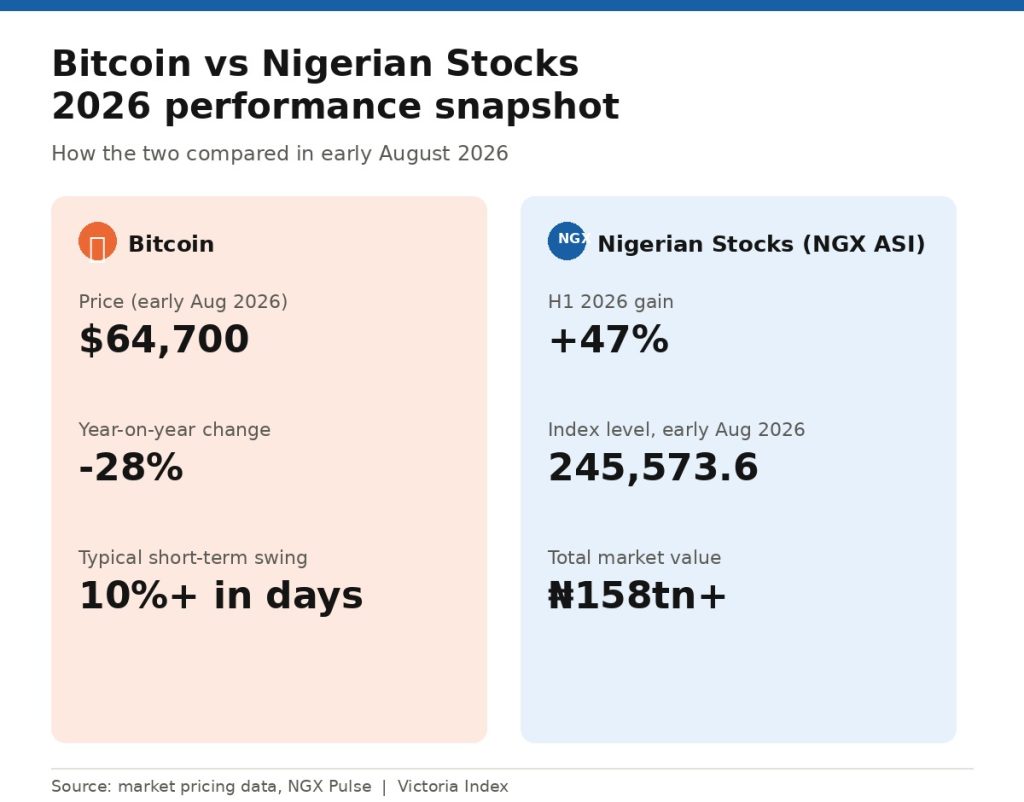
Let me begin with the facts, because without facts there is no reasonable discussion, particularly when it comes to numbers.
Bitcoin has not really been having a great year, to be completely honest. As of early August 2026, it was trading at around $64,700, down nearly 28 percent year-on-year, and well below the peak price it recorded a year ago. This has particularly been a sobering realization for many Nigerians who have bought into crypto before, considering the meteoric rise it has had within a very short period of time, and how sharply it has fallen within practically the same period.
On the other hand, the Nigerian stock market has had a very good year, at least so far. While the NSE All-Share Index closed the first half of the year at around 47 percent gain, for the first week of August, the reading stood at 245,573.6, with a market value of over 158 trillion naira. Overall, Nigeria has had one of the best stock performances in Africa this year. I track the daily movements myself through NGX Pulse’s live market data. It is very evident that at least for this year, the Bitcoin vs Nigerian stocks debate does not really have a winner. At least not for now.
Realistically speaking, one year of performance will only tell you so much in the Bitcoin vs Nigerian stocks debate. If you think that simply because Bitcoin was performing better a year ago, it is automatically a better investment for the long haul, you are sorely mistaken. In the same way that Bitcoin has had its ups and downs, and Nigerian stocks have had their moments of sluggish performance as well. Even though the Nigerian stock exchange market has had a great year so far, I would rather not say it is necessarily a better long-term investment option.
The Bitcoin vs Nigerian stocks debate does not necessarily revolve around the investment potential either, although it sometimes does. Both instruments are really good ways of diversifying one’s portfolio, and I think that is probably the most important takeaway from the Bitcoin vs Nigerian stocks discussion.
According to Chainalysis’s Sub-Saharan Africa crypto data. Bitcoin has become popular as an alternative to local currency, particularly as a hedge against inflation and naira depreciation, and to allow Nigerians to participate in international transactions much more easily with less restrictions. However, Nigerian stocks really are an investment in actual companies which are earning money and paying dividends. The Bitcoin vs Nigerian stocks conversation is therefore not necessarily an either/or scenario, simply because the two are really very different types of investments. In fact, a lot of people that I know have been investing in both stocks and crypto, using the two as ways of diversifying their portfolios.
If you would like to read more about how the Nigerian stock market fits into the local economy and how both stocks and cryptocurrencies are seen by investors, this piece really opened my eyes to the local perspective.
If the investment potential and ease of diversification are not really deciding factors for the Bitcoin vs Nigerian stocks debate, then it must boil down to risk. And risk really is a huge factor in determining whether someone should consider Bitcoin, Nigerian stocks, or even a mix of the two.
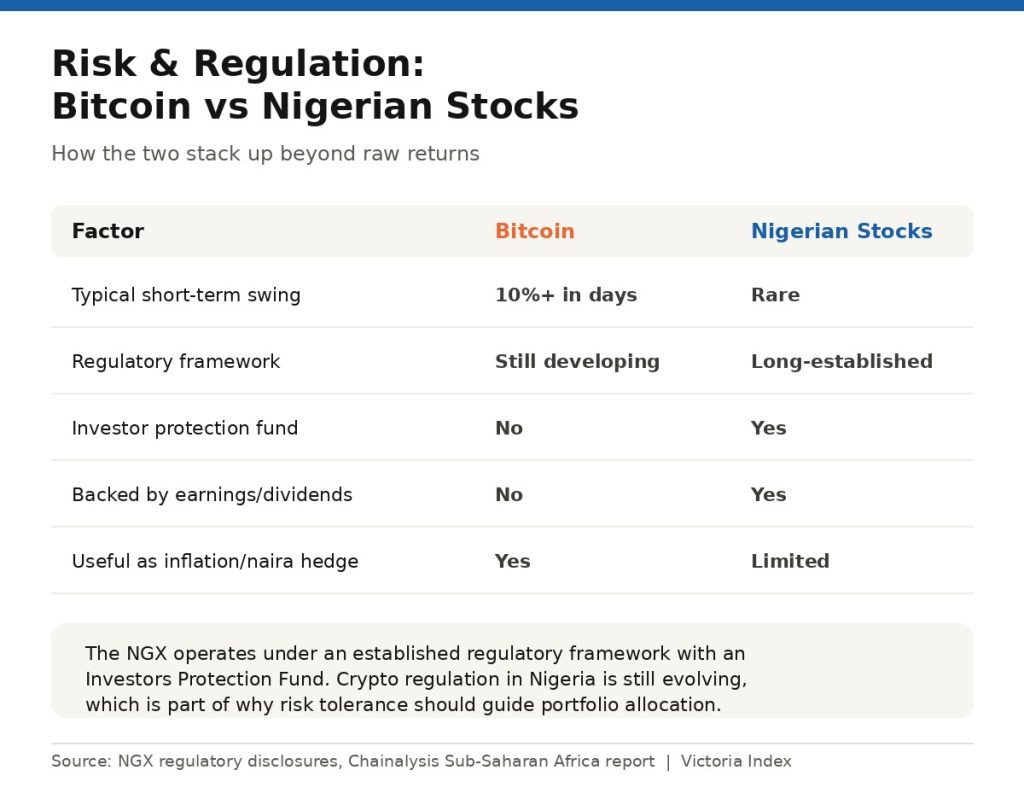
The volatility of crypto and stocks really is night and day, with Bitcoin being much, much more volatile. It is not uncommon for it to move more than 10 percent up or down within a matter of days, whereas such movements for the stock market are rare. Volatility is a double-edged sword and so is Bitcoin’s, seeing as some people who bought in when it was low have reaped massive rewards, while others who bought in when it was high are currently losing money. It really is a very situational investment, and I found this breakdown of what that means for everyday crypto users helpful for understanding the current rules. I think Nigerian stocks are a safer investment in terms of volatility, although they are definitely not without their own risks, seeing as how they are prone to long periods of stagnation.
It is also important to note that the Nigerian stock exchange has had a very robust regulatory framework ever since its establishment, and it is protected by law. The NGX regulation also protects investors in case of securities fraud, and there is even an Investors Protection Fund to help restore funds in case of a licensed brokerage default. On the other hand, Bitcoin and cryptocurrency in general is still a relatively nascent space, and there are still loopholes in Nigeria’s cryptocurrency laws which can be exploited, although that may change soon enough.
I think it goes without saying that my thoughts on the Bitcoin vs Nigerian stocks debate are not black and white. I really think that the discussion should focus on what the investors want and need.
For me, when it comes to the Bitcoin vs Nigerian stocks discussion, I think I want to invest in Nigerian stocks as they offer a very stable income stream in the form of dividends. I personally prefer to invest in blue-chip stocks like banks, oil and gas, and other industries synonymous with steady income. However, I also have a small allocation for crypto, as it serves as a nice hedge against inflation and naira depreciation, and diversifies my portfolio, although I would never risk putting more than a small amount of my total investment savings there. I think that is probably the biggest lesson I have learned from this whole experience.
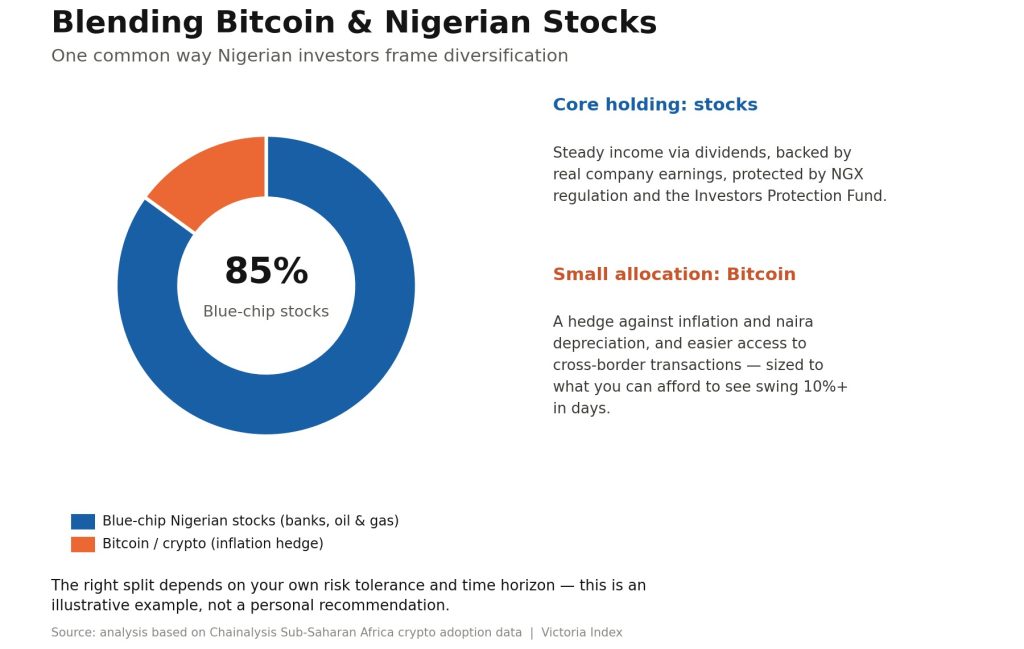
The amount of money that one has should really dictate the risk factor, in my opinion, which is a huge factor in the Bitcoin vs Nigerian stocks discussion, but many seem to ignore it. Someone with only five percent of their portfolio in crypto is not in the same boat as someone whose portfolio is fifty percent crypto, even though they might have both decided to invest in crypto because it has been doing well. These are some of the things that I think should be considered when having the Bitcoin vs Nigerian stocks debate.
When it comes to Nigerian investors entering the year 2026, I think it is important that they should take some time to consider their needs. When talking about the Bitcoin vs Nigerian stocks discussion, I think it is important to ask yourself two major questions. First off, how will you feel if your investment drops twenty or thirty percent within a matter of weeks? Second, what are you investing for? A retirement fund and a speculative investment will have very different approaches, particularly when talking about the Bitcoin vs Nigerian stocks debate.
Nigerian stocks have had very good performance this year, and it really is well-deserved, considering the efforts at recapitalization in the banking sector and the booming oil and gas sector, among others. Bitcoin, on the other hand, is still a huge long-term investment vehicle with very rewarding potential, even if it has had some turbulent days in 2026. I think we can all agree that when it comes to the Bitcoin vs Nigerian stocks debate, it is a long-term game.
Ultimately, I think the Bitcoin vs Nigerian stocks discussion should really be about what suits each person individually, rather than what has been performing better, at least for now. It really is a matter of diversifying one’s portfolio and doing research, and I think Nigerian investors should do just that when considering the Bitcoin vs Nigerian stocks debate.
This article is for general information and educational purposes only and should not be treated as personalized investment advice. Share prices can rise or fall, and readers should do their own research or speak with a licensed financial adviser before making any investment decision.