Physical Address
Victory Est, Ogombo Ajah, Eti-Osa, Lekki 101245, Lagos
Physical Address
Victory Est, Ogombo Ajah, Eti-Osa, Lekki 101245, Lagos
Nigeria Financial News, Stock Market Data, Economy & Market Analysis
Nigeria Financial News, Stock Market Data, Economy & Market Analysis
Tinubu, NGX Group, and BPE are quietly aligning on listing NNPC, NLNG, and other state assets. Here's what's actually confirmed.
For quite a while now, the notion of the government-owned behemoths of Nigeria’s public sector participating on the NGX has been talked about more as a wishful thinking concept than a tangible objective. The tide is turning now. In the last couple of weeks, a series of announcements from the presidency, Nigerian Exchange Group, and the Bureau of Public Enterprises has quietly aligned themselves into what can be considered a strategy.
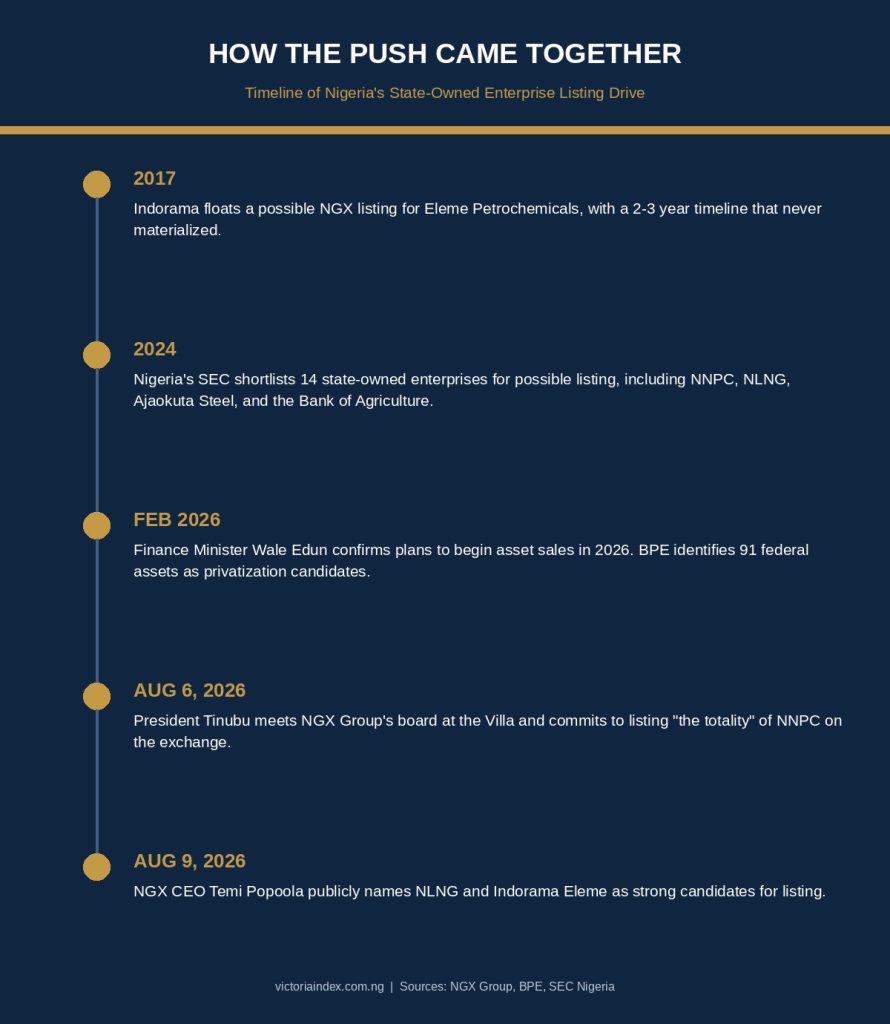
President Bola Tinubu of Nigeria held meetings with the board and management of NGX Group at the Presidential Villa in Abuja on August 6, 2026. In the meetings, Tinubu promised to make reforms that will lead to the listing of the Nigerian National Petroleum Company in the capital market. He was clear on the extent of reforms he intended to make, stating his intentions to see “the totality” of NNPC listed on the exchange.
The NGX Group highlighted four key strategic initiatives the federal government of Nigeria must pursue at the time of the meeting. These initiatives include the privatization and listing of commercially viable government assets, the implementation of dual listings for the top-performing companies of Nigeria, setting of policy on taxation of capital gains on securities listed in the exchange, and increased use of capital market instruments to finance infrastructure. The chairman of NGX Group, Umaru Kwairanga, referred to the initiative as a major endorsement of the increasing role of the capital market in development.
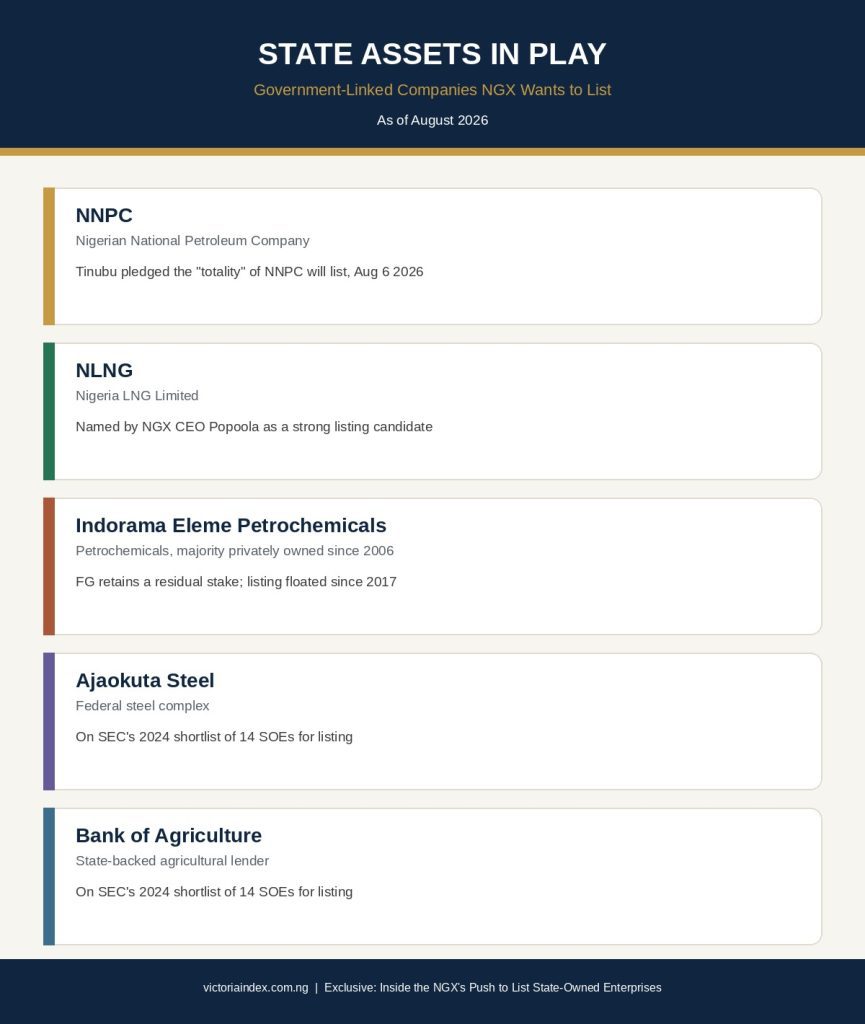
Here comes the meat of the matter. Not many days had passed from the Villa conference when NGX Group CEO Temi Popoola singled out specific companies for future public listings. At a public event, Popoola highlighted Nigeria LNG Limited, Indorama Eleme Petrochemicals and chosen assets from the NNPC portfolio as the companies with all necessary legal framework in place to potentially go public.
But it’s nothing new for the Nigerian securities regulator. In 2024, SEC had come up with a short list of 14 SOEs eligible for a public listing which included not only NNPC and NLNG, but also Ajaokuta Steel and the Bank of Agriculture. The difference is in the degree of political will now. In a separate announcement, BPE listed 91 federal assets in oil, power and other industries which can be privatized. This is confirmed by Finance Minister Wale Edun who said the government plans to start the process with some of these assets in 2026.
Indorama Eleme Petrochemicals deserves a closer look, because its history complicates the “state-owned enterprise” label a little. The plant was originally established by the federal government through the old Nigerian National Petroleum Corporation and began operations in 1996. In 2006, the government sold 75% of the company’s equity to Indorama for $225 million, and subsequent transactions have left the Federal Government holding a much smaller residual stake. Indorama’s takeover is widely credited with turning around a plant that had struggled under state ownership, converting it into a major producer of polyethylene and polypropylene.
This actually makes a potential Indorama listing more interesting rather than less. It wouldn’t be a conventional state-to-public handover; it would be a public valuation of an asset already split between private ownership and a residual government stake. Indorama itself floated the idea of an NGX listing back in 2017, with a timeline of two to three years attached to it at the time. That timeline came and went without a listing materializing, which is worth remembering before assuming this round of momentum guarantees a different outcome.
The discourse on the part of Popoola hinged on a bit of history that is conveniently forgotten: Some of the blue-chip firms listed on the NGX were listed on account of some previous listing drives carried out by the government. The listing of Nestle and Unilever in Nigeria can be linked back to the indigenous policy drive of the 1970s. On the other hand, the listing of MTN was done in response to some other sort of governmental pressure. The argument of the NGX is essentially that such practices have served to strengthen rather than weaken the exchange and that state-owned firms are just another step in the same direction.
It’s a reasonable historical argument, but it also glosses over how long these things tend to take and how often they stall for reasons that have nothing to do with market readiness. Nigeria’s own privatization history, tracked closely by Victoria Index in its coverage of Nigerian banks’ recapitalization and restructuring, shows that ambitious capital market reforms in this country tend to move in fits and starts rather than in a straight line.
None of these listings are imminent. But the direction of travel matters for anyone building a long-term NGX position. If even a portion of NNPC, NLNG, or Indorama Eleme eventually lists, it would represent some of the largest single additions to the exchange’s market capitalization in its history, alongside the already-anticipated Dangote Refinery listing valued at roughly $39.1 billion. That combination has analysts openly discussing a fundamentally larger, more liquid NGX within the next few years, which is part of the broader bull run context Victoria Index unpacked in its exclusive look at what investors need to know about the NGX boom.
A bigger, more diversified index also changes how existing NGX-heavy portfolios are weighted. Energy and industrial exposure that’s currently concentrated in a handful of names could become considerably more spread out if even two or three of these state assets actually list. That’s a meaningful structural shift worth tracking closely rather than reacting to only once it happens.
The realistic next milestones are the finalized BPE asset list, expected sometime in 2026, and any formal SEC filing activity tied to NNPC or NLNG specifically. Until either of those materializes, this remains a political commitment backed by public statements rather than a confirmed listing timeline. Given how long the Indorama listing idea sat dormant after 2017, that distinction matters. For now, the clearest signal is that the pressure is coming from multiple directions at once, the Presidency, NGX Group’s leadership, and the regulatory shortlist that’s existed since 2024, which is a different, more coordinated posture than Nigeria’s privatization push has had in years.
For readers who want to track the underlying data directly, NGX Group’s official statement on the Villa meeting and the Bureau of Public Enterprises remain the two primary sources worth bookmarking as this story develops.