Physical Address
Victory Est, Ogombo Ajah, Eti-Osa, Lekki 101245, Lagos
Physical Address
Victory Est, Ogombo Ajah, Eti-Osa, Lekki 101245, Lagos

Nigeria Financial News, Stock Market Data, Economy & Market Analysis
Nigeria Financial News, Stock Market Data, Economy & Market Analysis

Nigerian energy tickers keep swinging with every global oil headline, and I have broken down exactly why that connection is so tight.
Nigerian energy tickers have been nothing but exciting in the past few weeks, as every time a geopolitical development involving oil prices hits the wire, my fingers instinctively go to check the share prices of Seplat and Oando. Their strong correlation to the global benchmark crude price is something I think every NGX investor can benefit from understanding, and what better way to learn the dynamics of Nigerian energy stocks than to delve into why and how they relate to oil price fluctuations.
There is a reason why Nigerian energy tickers follow the trends of crude oil prices so intensely, and it begins with a simple understanding of what these stocks represent. According to MansaMarkets research, Seplat Energy is not only the largest indigenous oil exploration and production company but also the most oil price sensitive stock on the Nigerian Exchange. The company’s upstream orientation makes its revenue stream directly dependent on the ebb and flow of Brent crude prices.

Similar sentiments can be said about Oando Plc, although TotalEnergies Marketing Nigeria differs greatly from its peers in this regard due to having a downstream orientation, making it less sensitive to changes in the price of oil. The recent oil price increases have a direct impact on Nigerian energy stocks, particularly those involved in upstream activities like Seplat Energy. A look at the movements in Brent crude this year sheds light on why Nigerian energy tickers behave the way they do. Per TradingEconomics data, the global benchmark climbed to $91.1 per barrel on July 21, 2026, marking a 2.11% increase from the close of the previous trading day and a whopping 32.82% year-over-year (Y-O-Y) rise.
In the past month alone, prices jumped 16.95%, primarily driven by heightened geopolitical tensions between the US and Iran, with the latter’s Houthi movement threatening to blockade the Red Sea. It is no surprise then that Nigerian energy stocks are also feeling the heat from the recent surge in global oil prices. Looking at the year-to-date (Y-T-D) chart on Fortune’s oil price tracker, Brent crude fluctuated between a low of $72.36 per barrel and a high of $91 per barrel in July 2026, posting a significant increase in just two short weeks. In fact, according to Forbes Advisor’s article, the 52-week range for Brent crude is between $58.66 and $120.88, with the price peaking in April 2026.
All of these swings in the price of oil have a direct impact on Nigerian energy stocks, sending their share prices higher in the wake of a bullish movement in crude prices and lower in the wake of a bearish one.
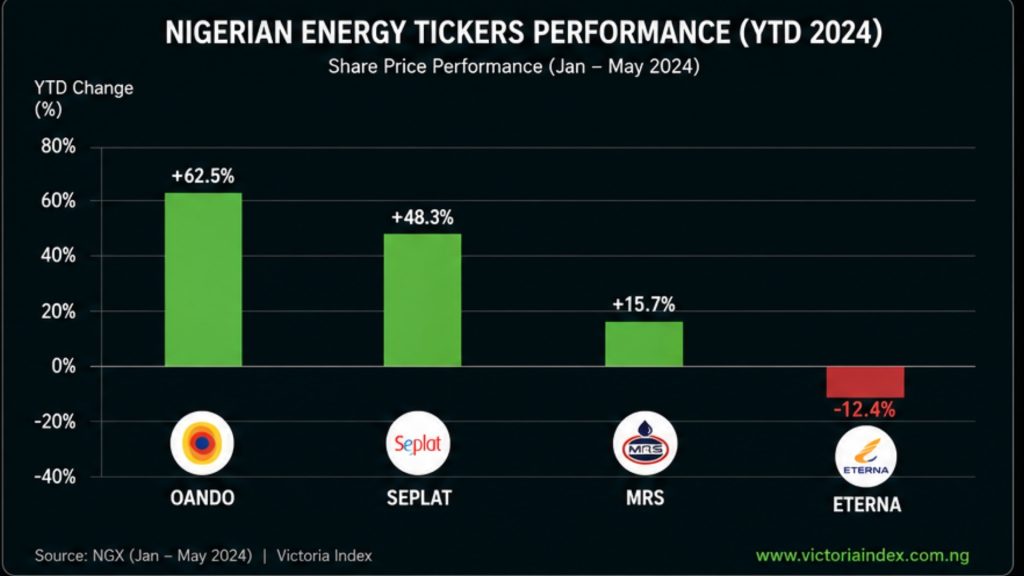
Seplat Energy has been a poster child for Nigerian energy stocks that are directly linked to the price of oil. According to data published by NGX Pulse, the company’s share price has been trading between N5,379.3 and N11,600 in the past year, while its market cap is valued at approximately N6.82T as of mid-July 2026.
As reported by StockAnalysis in its Seplat Energy stock research note, the company’s production jumped 148% Y-O-Y in 2025, while its revenue grew 144% on the back of the acquisition of Mobil Producing. Meanwhile, analysts at Citi raised their price target on Seplat Energy’s London-listed shares to 655 pence from 415 pence, maintaining a Buy rating on the stock, citing increased earnings potential on the back of higher oil prices. Nigerian energy tickers like Seplat Energy are valuable indicators for investors due to their sensitivity to the price of crude oil. In this regard, analyst upgrades on energy stocks are a telltale sign that institutional investors are taking greater interest in these securities due to their expectations of higher oil prices.
Not everything that impacts Nigerian energy tickers is directly linked to the price of oil, however, as evidenced by recent developments at Seplat Energy. Specifically, as revealed by StockAnalysis research note, workers at Seplat Energy went on an indefinite strike due to disagreements with management over welfare and collective labor bargain issues, which could negatively impact the company’s production at a time when oil prices are at a multi-year high. The strike was called off once the company submitted its proposals on wage increases in writing to the workers.
I think investors who are considering Nigerian energy tickers as part of their diversified NGX portfolio should be mindful that while movements in the price of oil are directly reflected in these stocks, other developments affecting individual companies can also contribute to share price movements. In this regard, I think it is crucial to look at both global and local factors when assessing why Nigerian energy stocks behave the way they do.
One interesting observation that comes out of MansaMarkets report is that while oil prices directly influence Nigerian energy tickers, they also indirectly impact other stocks listed on NGX due to their impact on the Nigerian economy. Higher oil prices translate into greater revenues for NNPC and the CBN, which in turn stimulates the naira and has a positive impact on the rate of inflation. Consequently, a strong local currency and lower inflation encourage foreign portfolio investments into NGX, which benefits all stocks, energy tickers included. This indirect impact of oil prices helps explain why movements in the NGX Oil and Gas Index frequently precede those of the NGX All Share Index.
In other words, Nigerian energy stocks are not only directly correlated to the price of crude oil but also indirectly influence the wider market due to their weight on the exchange. Nigerian energy tickers can be a great barometer for investors to use when timing their entries and exits in NGX, so long as they understand what drives their price movements.

Based on my analysis of why Nigerian energy tickers are such a direct proxy for oil prices, I think the most important lesson for investors looking to add these stocks to their portfolio is to embrace the volatility that comes with them. Seplat Energy and its peers are extremely sensitive to fluctuations in the price of crude oil, which means their share prices will also swing considerably in response to geopolitical developments thousands of miles away in the Middle East.
In my opinion, only investors that are willing and able to ride out the turbulence in Nigerian energy tickers stand to profit from investing in them in the long run. That is not to say these stocks should not be considered by more conservative investors, however; rather, I think it is important for them to understand the dynamics of these securities before committing hard-earned capital to them.
While I am focusing this discussion on Seplat Energy and Oando, there are several other energy stocks that can also benefit from rising oil prices. Per NGX Pulse research, there are multiple oil and gas exploration and production companies listed on the exchange, including Aradel, Conoil, and JapaulGold, each of which has varying levels of exposure to the upstream segment. In fact, Conoil is more similar to TotalEnergies Nigeria due to its focus on fuel marketing and lubricants rather than oil production, which means it is less directly exposed to changes in Brent crude prices.
In short, investors who are considering Nigerian energy tickers as a way to profit from higher oil prices have multiple options at their disposal, each of which has different levels of exposure to the swings in the price of crude oil. For example, those looking to take advantage of higher oil prices while limiting downside risk should consider Nigerian energy stocks with a downstream focus, whereas those unafraid of volatility in pursuit of greater rewards may want to look at upstream-oriented counters like Seplat Energy.
Having watched Nigerian energy tickers climb and fall in tandem with developments in the global oil markets, I think my readers would benefit from understanding what drives these stocks and why they are such a popular proxy for oil prices. From my analysis, Seplat Energy, Oando, and their peers are directly impacted by the ebb and flow of Brent crude prices, as well as broader geopolitical developments that indirectly affect the Nigerian economy. As long as global oil markets remain as unpredictable as they have been in recent months, I do not see Nigerian energy tickers becoming any less exciting in the near future.