Physical Address
Victory Est, Ogombo Ajah, Eti-Osa, Lekki 101245, Lagos
Physical Address
Victory Est, Ogombo Ajah, Eti-Osa, Lekki 101245, Lagos
Nigeria Financial News, Stock Market Data, Economy & Market Analysis
Nigeria Financial News, Stock Market Data, Economy & Market Analysis
No employer means no automatic pension. Here's how self-employed Nigerians can build real retirement savings on their own terms.
However, if you are a sole proprietor running your consultancy firm or trading firm, a freelancer, or the owner of your own business in Nigeria, no one will sign you up for the pension plan. You do not have the human resources department that takes out a percentage of your earnings every month and contributes the same amount. Whatever pension plan that you are going to have in the future must be planned on your part from now and not “some day.”
It is the main reason why a lot of self-employed people in Nigeria find themselves having a booming business at 50 or 60 without anything left after they stop operating. Today’s income does not equal income in twenty years automatically.
The factors are practical in nature rather than an absence of self-discipline. For self-employed individuals, incomes can vary greatly. A good month can yield thrice as much as a poor one, making monthly contributions trickier to budget for compared to a salaried individual. Then there’s the allure of investing back into their business through new stock, new equipment, employee salaries, and even rental costs. Retirement may seem like a distant affair as opposed to a current financial dilemma.
What’s more, many individuals believe that pension schemes are meant for salaried individuals under the Contributory Pension Scheme. This was more or less true in the past. Not anymore.
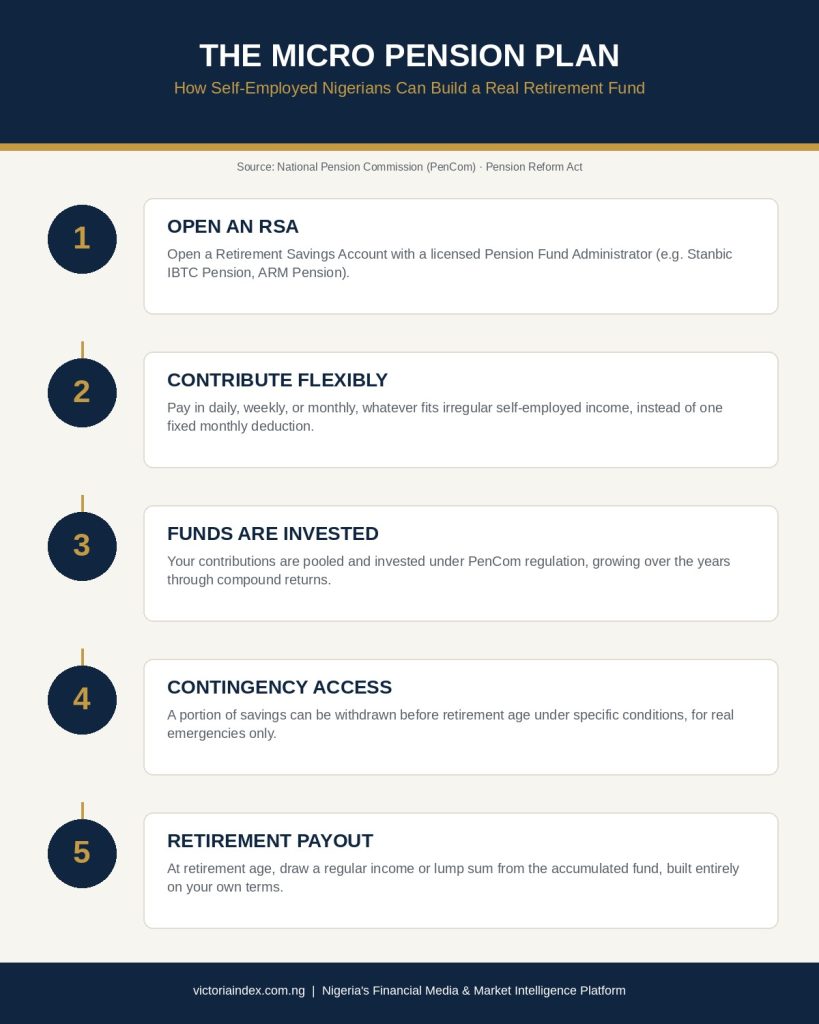
In 2019, the National Pension Commission introduced the Micro Pension Plan under Nigeria’s Pension Reform Act, specifically to bring self-employed and informal-sector workers into the formal retirement savings system. You can read the details directly on PenCom’s official site, but the core idea is straightforward: you open a Retirement Savings Account with a licensed Pension Fund Administrator, contribute whatever amount fits your income, whenever it fits, and the fund grows through regulated investment over time.
In comparison to the traditional approach where you are expected to pay contributions every month, contributions in the present case offer a lot of flexibility as you are allowed to make them daily, weekly, or monthly based on your payment flow. The two companies that develop micro pensions based on this type of payment flow are Stanbic IBTC Pension Managers and ARM Pension, among others, and it is important to compare them prior to making a choice.
There is an additional opportunity to withdraw part of your funds prior to retirement age through contingency withdrawal included in the scheme. This is very convenient for those who are self-employed and sometimes need money in the business.
A Retirement Savings Account shouldn’t be the only leg of the plan. Diversifying beyond it gives more control and, often, better liquidity.
Dividend-paying stocks on the NGX are one route worth understanding properly before committing money, and Victoria Index’s coverage of smart investment options for young Nigerians is a reasonable place to start if this territory is unfamiliar. Real estate, particularly rental property in growing areas, is another common choice among self-employed Nigerians who want an income stream that doesn’t depend on actively running a business day to day.
Whatever mix is chosen, the debt side of the equation matters just as much as the savings side. Retirement contributions get squeezed out fast when a chunk of monthly income is going toward servicing loan-app debt at high interest rates, a pattern covered in more depth in Victoria Index’s piece on Nigeria’s rising cost of credit. Clearing expensive debt first tends to free up far more retirement capital than chasing a slightly higher investment return while still paying 15% a month somewhere else.
One thing salaried employees have that self-employed people don’t is automation. Their pension contribution disappears from their account before they ever see it. Self-employed Nigerians can recreate that same effect manually, and it’s worth treating it as non-negotiable rather than optional.
A simple approach: whenever money comes in from a job, invoice, or sale, move a fixed percentage, even 10%, into the retirement account immediately, before it touches the account used for daily spending. The exact structure doesn’t need to be complicated. Victoria Index’s guide on how to save money effectively in Nigeria covers a version of this with the 50/30/20 framework, and the same logic applies here: treat the retirement portion like a bill that has to be paid, not a leftover.
Apps like Cowrywise and PiggyVest also offer target-savings and long-term investment plans that can sit alongside a formal RSA, which is useful for anyone who wants a second, more liquid pot dedicated purely to long-term goals.
The risk isn’t abstract. Without a dedicated retirement fund, a self-employed person’s entire financial security tends to rest on the business staying healthy indefinitely, which is rarely how businesses actually work over a 20 or 30-year span. Health issues, market shifts, or simply age can shrink or end income from a business well before a person is ready to stop needing money.
This is also where a solid emergency fund earns its keep, since it prevents short-term shocks from forcing early withdrawals out of long-term retirement savings. Victoria Index’s guide to building an emergency fund in a volatile economy pairs well with retirement planning for exactly this reason: the two protect different time horizons, but they support each other.
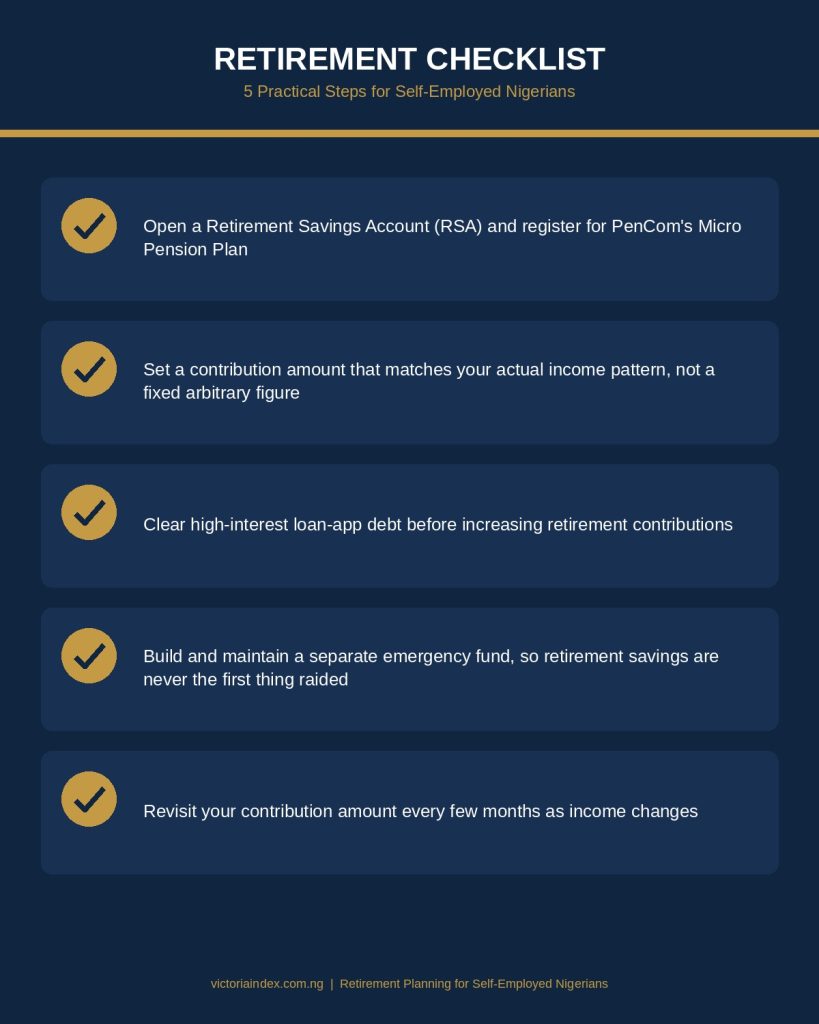
For anyone reading this and realising nothing is currently in place, the starting steps don’t need to be elaborate:
None of this requires a large income to start. It requires starting, and then staying consistent long enough for the contributions to compound. The self-employed Nigerians who reach retirement comfortably aren’t necessarily the ones who earned the most. They’re usually the ones who redirected a portion of what they earned, on purpose, for long enough.
This article is for general information and educational purposes only and should not be treated as personalized investment advice. Readers should do their own research or speak with their pension adviser before making any retirement savings decision.