Physical Address
Victory Est, Ogombo Ajah, Eti-Osa, Lekki 101245, Lagos
Physical Address
Victory Est, Ogombo Ajah, Eti-Osa, Lekki 101245, Lagos

Nigeria Financial News, Stock Market Data, Economy & Market Analysis
Nigeria Financial News, Stock Market Data, Economy & Market Analysis
How do Nigeria's tech founders actually live? From home offices to quiet wealth habits, here's the real lifestyle behind the funding headlines.
Nigeria’s tech has churned out some of the most covered, widely-discussed wealth narratives of the past few years – unicorn company valuations, multi-million dollar fundraising rounds, et cetera – the usual tech hustle suspects, really. But beneath the hype and media coverage of Series B, Series C-whatever raises, a quieter topic that has consistently appeared in your e-mails, or come up in reader interactions, is simple: what exactly does life behind those tech-entrepreneurial curtain look like? What did you have for lunch today? This article takes a look at how some of Nigeria’s most prominent tech founders eat, play, and relax, piecing their experiences from a handful of available interviews and profiles.
For most Nigerian founders, the story doesn’t start with a mansion; it starts with a desk. In Culture Custodian’s coverage of Rediscover TV’s “A Day In The Life” series, Sendstack co-founder Ifeoma Nwobu walks viewers through her actual daily routine in Lagos, covering everything from her apartment and morning habits to how she structures her workday around building a logistics startup. The episode’s popularity said less about luxury and more about how curious people are to see the ordinary, unglamorous side of building a company in Lagos.
That pattern shows up across the ecosystem. Podcast series like Founders Connect have built entire archives of interviews with the people behind companies such as Andela, Paystack, Kuda, Bumpa, and Eden Life, and a recurring theme is how much of a founder’s “home life” is really just an extension of the office: kitchen tables that double as war rooms and spare bedrooms converted into server-and-Slack command centers.
For more on how this generation of builders structures their day beyond the home office, our earlier feature on the daily habits of successful investors and entrepreneurs breaks down some of the routines that separate the consistent performers from the burnt-out ones.
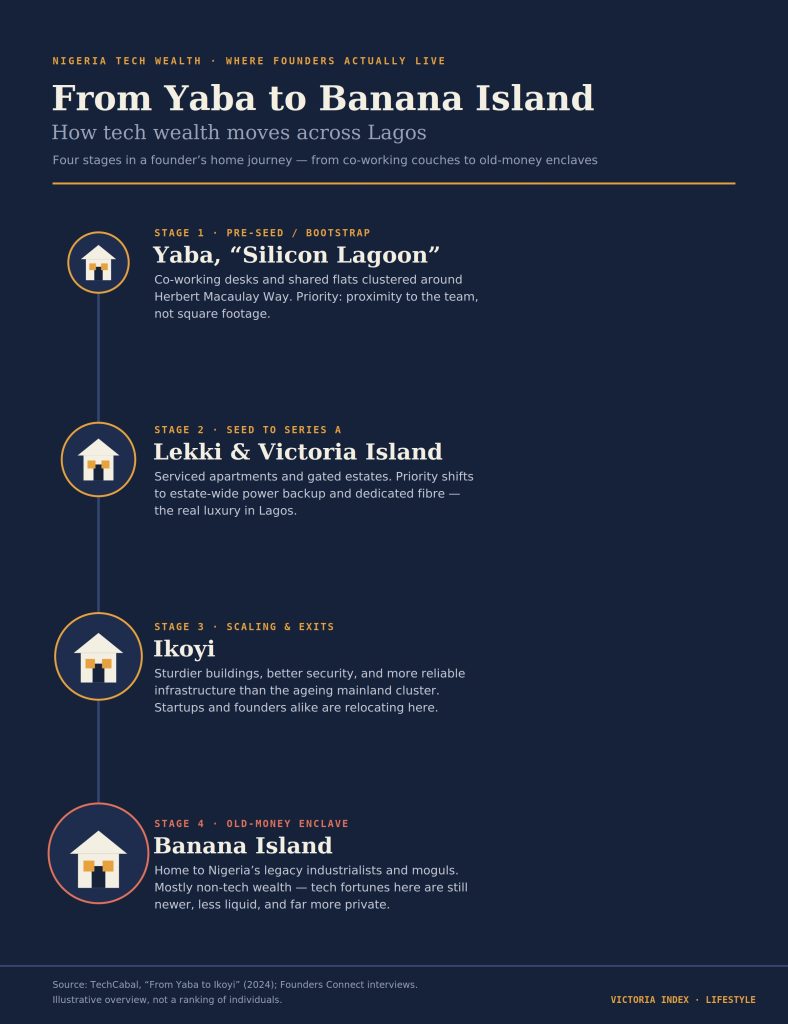
Geography matters more than most people realize when it comes to Nigerian tech wealth. For years, the ecosystem was clustered around Yaba, on Lagos’s mainland, a district that earned nicknames like “Silicon Lagoon” and “Yabacon Valley” as co-working spaces and startup hubs multiplied around the University of Lagos. More recently, though, that center of gravity has been shifting. According to TechCabal’s reporting on the move from Yaba to Ikoyi, a growing number of Nigeria’s better-funded startups and their founders have relocated toward Ikoyi, drawn by sturdier buildings, better security, and more reliable infrastructure than the ageing mainland cluster can offer.
As businesses get bigger and the founders decide to either seek new funding rounds or cash out, the same “centripetal forces” of geography at work in a city pull them also toward their respective enclaves as they consider where to live – increasingly north towards Lekki and Victoria Island, and beyond them, towards the traditional, old-money houses of Ikoyi and Banana Island which has since been housing Nigeria’s wealthiest industrialists and business magnates. The bulk of the very visible, widely circulated “mansion tour” pieces on these areas still often centre old industry titans and local entertainers over tech founders, as Nigeria’s newer breed of founders are typically much more liquid, but also much more private than the country’s oldest. Our roundup of the richest Nigerians and how they built their wealth has more on how those older fortunes were built and how tech wealth compares.
A theme that comes up again and again in founder interviews is that the home setup tends to be judged by function rather than flash. The two things founders mention wanting most consistently are reliable power and reliable internet, not marble floors. A Technext24 dispatch from Jobberman’s 2025 Remote WorkFest captured this directly, noting that unstable power and internet, along with generator noise disrupting calls, remain the single biggest home-office headache for Nigeria’s tech workforce, well ahead of anything related to comfort or luxury.
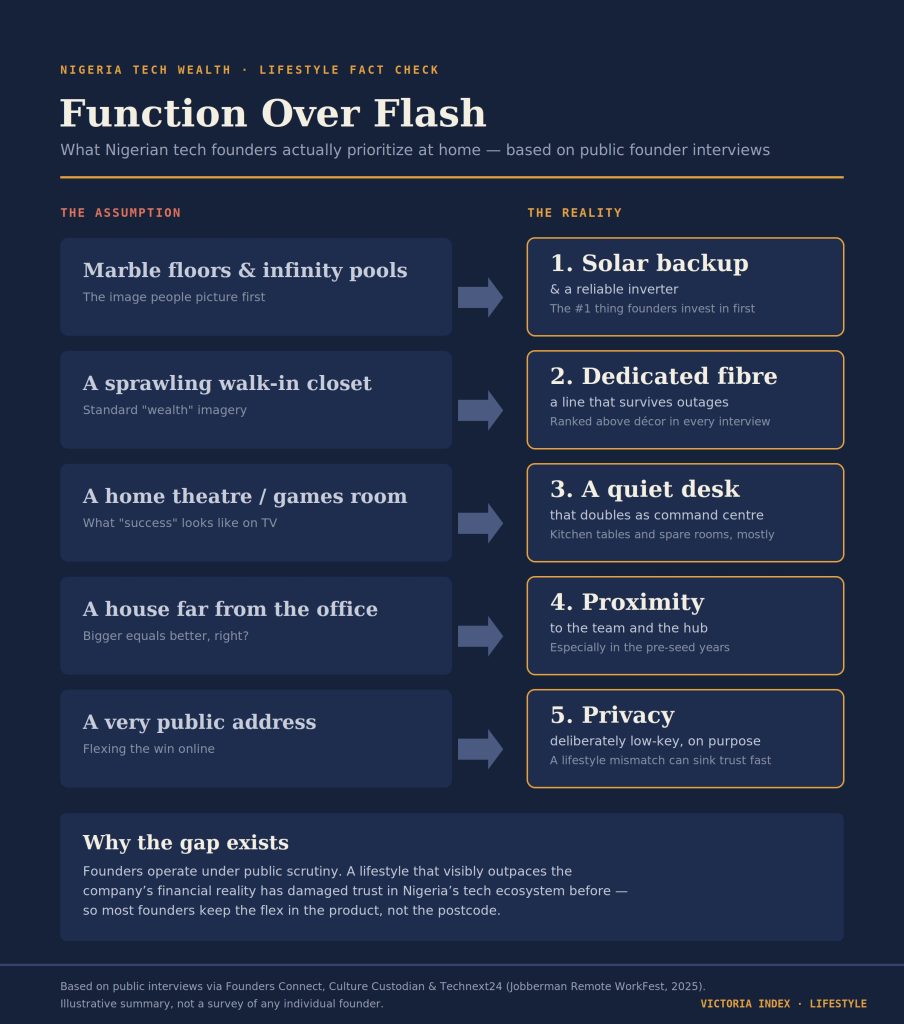
This is also why a good chunk of new founders and senior tech folks are now flocking to the newer service apartments and gated estates in mainland and Lekki, hoping for estate level power backup and Fibre installation, in place of a bigger dated property that’s just about looking good but constantly needs generator maintenance.
Perhaps the most consistent thing across founder interviews is how deliberately low-key most of them are about personal wealth, at least publicly. Andela and Flutterwave co-founder Iyinoluwa Aboyeji, who has spoken at length about his journey on Founders Connect, tends to frame his success in terms of the companies and funds he’s built rather than personal lifestyle upgrades. There’s a level of it cultural and there’s a level of it strategic. While other founders perhaps have less publicity surrounding them as entrepreneurs than Nigerian founders arguably do, having a private life that is in stark opposition with how your business is actually doing has damaged reputations in the ecosystem already.
This is largely why you can find a LOT more home tour content, about the businesses of legacy entrepreneurs than technology founders. The latter exist just as real, but the group of people in the process of making money from it has thus far decided to maintain some semblance of privacy when it comes to it.
The real story isn’t the square footage, or the water-front property of Nigeria’s highest-paid tech founders; it’s the close knit integration between work and home for the years that it takes to create a company and the care that most Nigerian founders seem to take not to over expose themselves even when the exit and funding offers are pouring in. Perhaps this will change over time as Nigeria’s tech sector grows and its first wave of creators reaches the wealth status that many of the more “traditional business folks” had already achieved. But for now, the more interesting story is found in the office, not the living room, that sits within their homes.