Physical Address
304 North Cardinal St.
Dorchester Center, MA 02124
Physical Address
304 North Cardinal St.
Dorchester Center, MA 02124

Nigeria Financial News, Stock Market Data, Economy & Market Analysis
Nigeria Financial News, Stock Market Data, Economy & Market Analysis
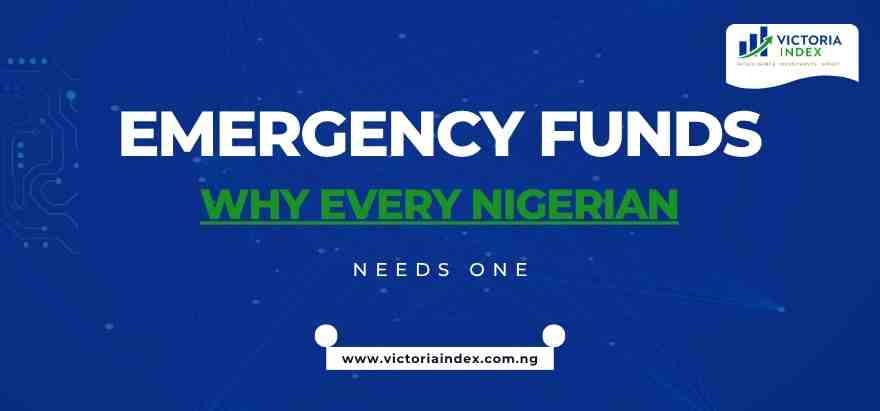
One could easily say that understanding the significance of having emergency funds and ensuring that every Nigerian individual needs one is much more than financial advice and rather is an obvious point where there is either survival or sliding further towards bankruptcy.
While many people associate financial planning only when large amounts of money start flowing into their pockets, reality on the ground depicts an entirely different picture. Without proper protection during inflationary periods, financial shock can see your years’ worth of savings vanish within minutes. This is why let’s consider the factors that can justify why it is important to have separate funds for your financial protection.
Let’s first clarify what an emergency fund means. An emergency fund is not an investment portfolio for investing in stocks but a savings portfolio that solely helps one face a financial emergency.
When considering the reasons for why each Nigerian should have an emergency fund, the first reason that comes into mind is accessibility of the funds. An emergency fund is your own insurance from any kind of employment problem or any problem that can arise regarding a business. Since you cannot predict how soon something will happen to you, you should make sure that this money is kept away and is not invested in anything that would take weeks to convert into cash.
The kind of shock you will experience will depend on your occupation and the place where you are based in Nigeria.
For tech professionals in Lagos, the primary financial shock risk comes from job insecurity. Any restructuring in global companies may make you lose your high paying job or position. It is vital to be financially liquid enough to meet your rent and subscription costs while searching for other international jobs.
In Oyo State, business people in Ibadan have constant operation risks. If there is any unexpected electrical power fault that may burn your store’s refrigerator or some logistical problems cause the destruction of raw materials, your entire operations are interrupted. An emergency fund helps you make urgent repair works without stopping your work or breaking your contract with suppliers.
In the northern part of Nigeria, agro-dealers in Kano operate in an environment highly affected by environmental and physical risks. Unexpected pests that destroy stored crops, transportation barriers across state lines, or unexpected drops in the price of wholesale grain may tie up large amounts of capital in non-productive investments. With a liquid emergency fund, you keep your family comfortable during difficult cycles of prices in the market.
In Nigeria’s capital, civil servants who work in Abuja sometimes face time-related problems that may delay their payment, either due to delays in receiving federal allocations or because of prolonged processing periods. Having an alternative source of funds helps you avoid resorting to dangerous loans simply to cover expenses like transportation or educational expenses of your kids.
I need to be very honest with you about a huge issue eating away at family bonds all around our country. In situations where a crisis emerges and individuals don’t have savings, they become panicked. Under that pressure, they may choose the option of using unlicensed apps for mobile loans that offer cash in hand without any collateral.
“If the situation involves borrowing from loan apps in an emergency, think of it as dousing a burning building with premium gasoline. The extortionate rates and methods employed in debt collection would make it next to impossible for you to free yourself from the vicious cycle of debt.”
This aspect of human nature is exactly what Godwin Uche Fafemi often addresses through his mentorship of young professionals via HighJobLink Limited. It shouldn’t take an unforeseen emergency to ruin your peace of mind and career prospects.
As per the information provided by the Securities and Exchange Commission Nigeria Portal regarding financial safety alerts, the responsibility lies with the individual to ascertain the legality and registration of any financial service institution. With your own savings, you eliminate the need for the services of those risky corporations altogether.
Saving up for six months’ worth of living costs can be overwhelmingly daunting. However, a mountain isn’t made in one day; it takes bricks. And here is the exact sequence of events that I advise when trying to establish a cushion fund:
Take out a pen and paper tonight and determine your actual cost of living per month. Forget entertainment, luxurious services and non-essential spending altogether. Concentrate only on what is absolutely necessary to feed yourself, cover your utility bill, travel, and pay for housing. This is your true survival metric.
Since you have already understood that in order to create an effective barrier, which, according to emergency funds why every Nigerian needs one, must be based on actual reality, the emotionality factor should not be taken into account. Open a direct payment order from your primary source of income or bank account. Allow for automatic transfer to a new account, 5 or 10 percent of the amount, exactly as soon as you receive the money.
Never let your emergency funds lie idle in a regular bank savings account, where the cost of maintenance of your ATM cards and other electronic transfers will eat away at your capital. Rather, deposit these funds in a legitimate money market mutual fund run by an authorized financial institution. Such investments give you inflation-proof returns while guaranteeing the security and liquidity of your funds within 24 to 48 hours. The legitimacy of registered investment companies can be verified through the banking listing on the Central Bank of Nigeria website.
| Fund Structure | Average Access Time | Risk Level | Primary Benefit |
| Traditional Savings Account | Immediate (ATM/App) | Low | High accessibility, but prone to impulsive spending and inflation erosion |
| Money Market Mutual Fund | 24 to 48 Hours | Very Low | Capital preservation, competitive yields, psychological barrier to casual spending |
| Fixed Deposit Receipt | 30 to 90 Days | Low | High discipline, but introduces penalty fees if you break the contract early |
Finally, the truth is that an emergency fund represents much more than merely a series of figures in a banking app. This is the source of your peace of mind in an uncertain economic environment. Once you realize that you have some savings in reserve to cushion you from the impact of emergencies, you approach life differently, especially financially.
There will always be times of uncertainty within the economic environment. Nevertheless, by making conscious efforts now in creating a protective net for yourself, you are already safeguarding yourself against financial downfall. Consider your emergency fund as a mandatory monthly expenditure, guard it against any form of unnecessary expenditure with intense determination, and witness how it becomes your strongest pillar towards building up your future wealth.