Physical Address
Victory Est, Ogombo Ajah, Eti-Osa, Lekki 101245, Lagos
Physical Address
Victory Est, Ogombo Ajah, Eti-Osa, Lekki 101245, Lagos

Nigeria Financial News, Stock Market Data, Economy & Market Analysis
Nigeria Financial News, Stock Market Data, Economy & Market Analysis

Taking into account your bank statement and trying to understand how you can build wealth with ₦50000 monthly income per month in this economic climate is like walking uphill while carrying weights on your legs. In light of the current expenses of buying food products, travelling and paying for electricity, surviving until you get your salary again is an achievement indeed. However, being the co-founder of VictoriaIndex Limited and working together with my beloved Godwin Uche Fafemi (CEO of HighJobLink Limited), I want to make you understand that it is possible to generate wealth with such an income anyway.
Earning money does not depend on the amount of money in your bank account as long as you are ready to invest some of your time and resources properly. If you master the skill of financial management with your limited monthly income today, you will have all the knowledge about handling considerable amounts of money in the future. Here is the strategy which will help you manage your monthly income and create a financial basis.
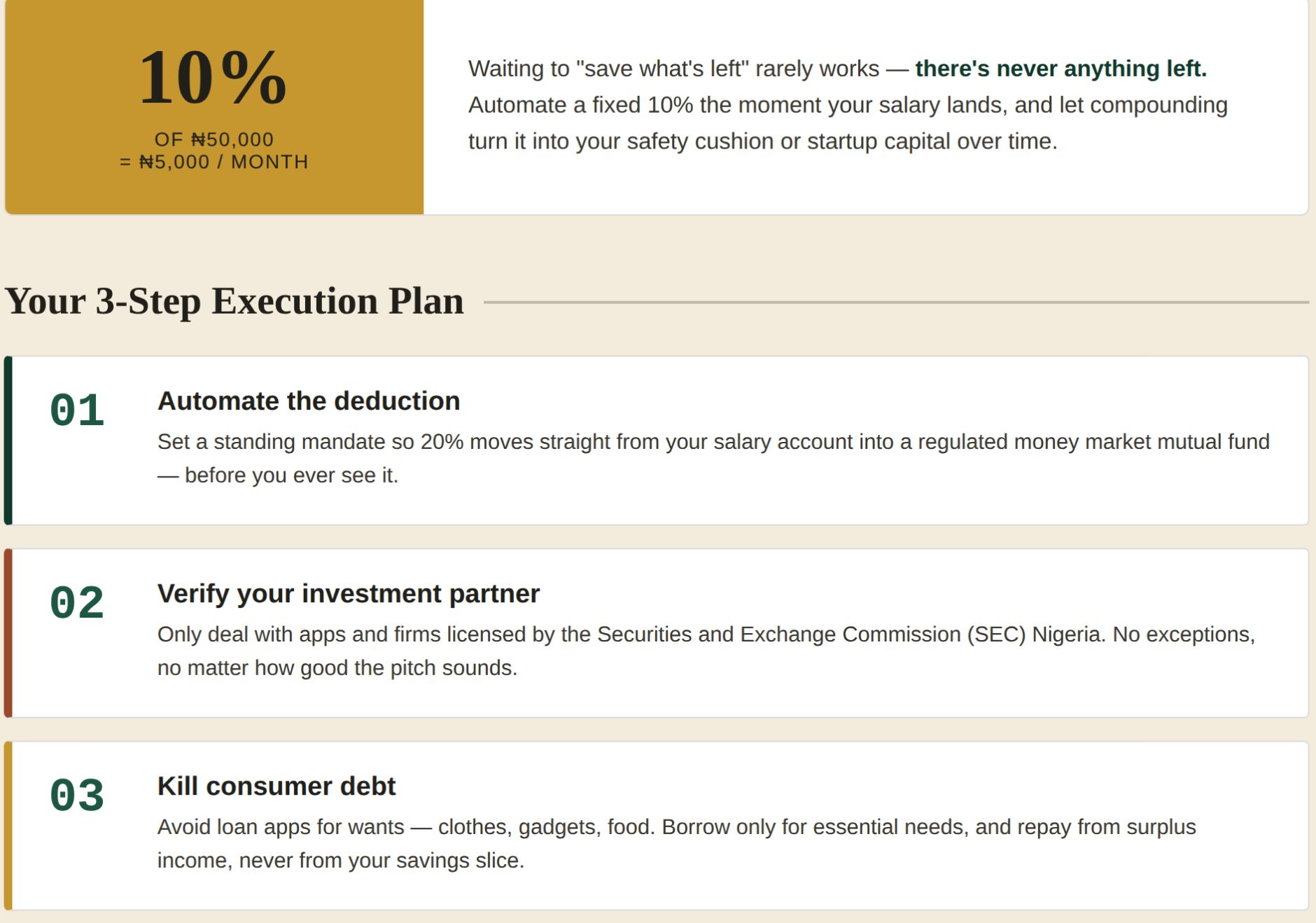
The commonest belief among individuals is “I will begin my investments when I have saved enough money”. It is the same belief that has left millions of people financially enslaved. Having limited resources does not necessarily make you a poor money manager.
The approach towards multiplying your finances based on a monthly salary of ₦50,000 involves taking full advantage of the power of compounding. For this to work, what it takes is the capacity to save 10% of your earnings per month, which amounts to ₦5,000. Through saving and investing of your funds monthly in your investment portfolio, you build a good flow of money. The compound interest of your investment grows together with your monthly savings and eventually becomes your safety cushion or capital for your business ventures.
While the method that you use to implement your plan is highly dependent on your geographical area and the economic environment therein, there are certain common practices which ought to be followed regardless of where you are in Nigeria.
Urban youth from cities such as Lagos come up with means of investing their money into high yield dollar/Naira saving pools through technology in an attempt to protect themselves from inflation and depreciation of their local currency. Instead of keeping loose cash in savings accounts which accrue maintenance fees per month, the youth can invest daily or weekly into high-yielding pools.
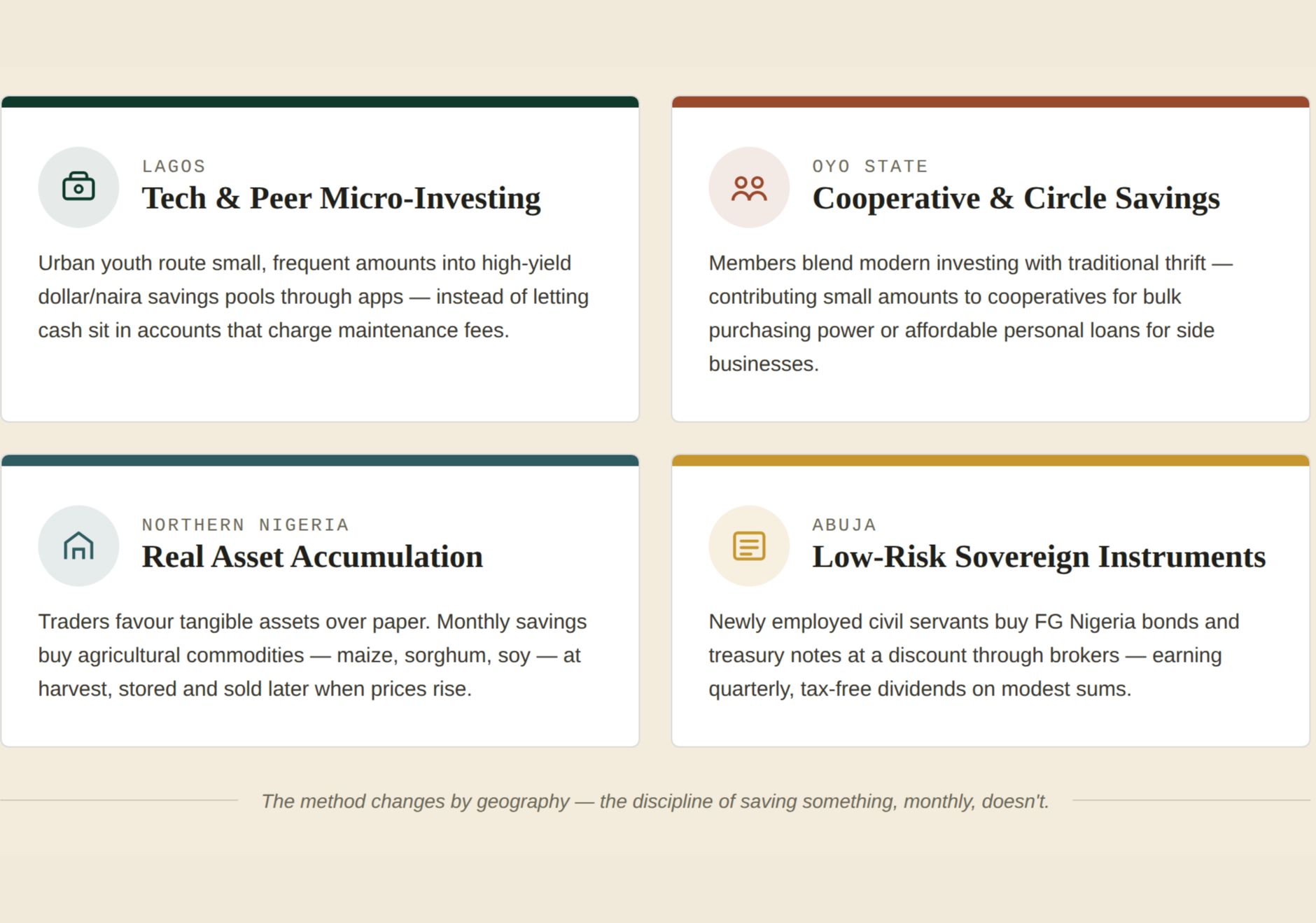
People in Oyo state, who have become financially literate, blend modern forms of investment with traditional forms of savings by investing in cooperatives whereby they contribute small amounts of money for buying things in bulk or taking cheap personal loans for developing side business activities.
Although traders at the northern region prefer investing in tangible assets and not on paper, they always have a way of saving whatever little money they earn each month for purchase of agricultural commodities such as maize, sorghum and soy in the harvest period and store them for future sale in the period of their shortages.
In Abuja, newly employed civil servants realize that they can make prudent and useful investments in FG Nigeria bonds and treasury notes sold at a discount by brokers who pay quarterly dividends without taxation.
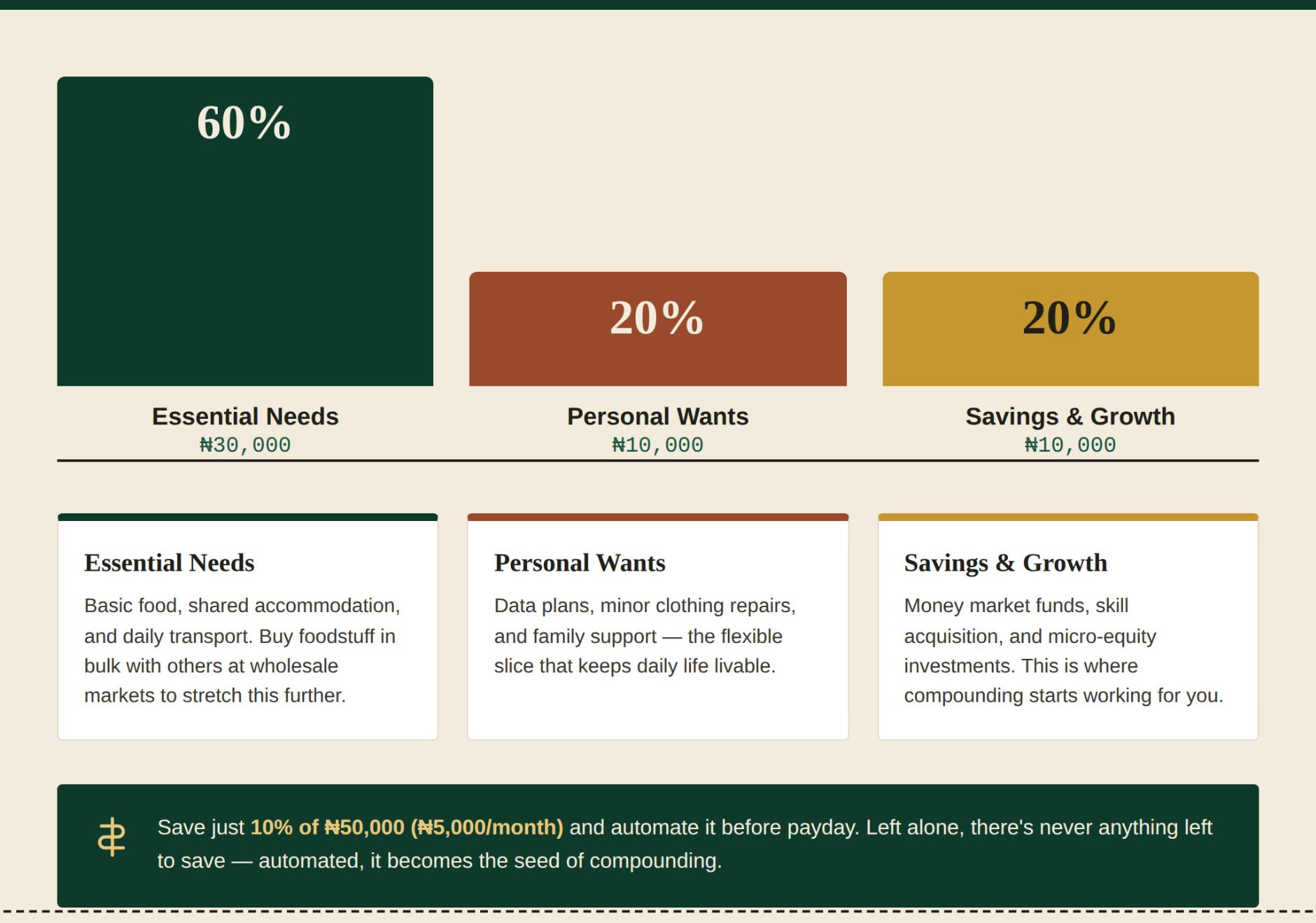
In order to efficiently earn money using a ₦50,000 per month salary, there is need for total governance of your budget just as how any multi-national company manages theirs. It is strongly recommended that you adopt the following budgeting formula:
| Budget Category | Percentage Allocation | Exact Monthly Value | Primary Target Items |
| Essential Needs | 60% | ₦30,000 | Basic food, shared accommodation, daily transport |
| Personal Wants | 20% | ₦10,000 | Occasional data plans, minor clothing repairs, family support |
| Savings & Growth | 20% | ₦10,000 | Money market funds, skill acquisition, micro-equity |
This is exactly what I know what you mean: “₦30,000 will not even be enough to feed me for a week, let alone a month!” The strategy of hyper localization and mass purchasing is exactly what we need here. Purchasing your basic foodstuff collectively with other people at wholesale markets will drastically cut down on your cost of living and allow you to maintain your savings objective.
Here we need to come to our senses. It is fantastic to save ₦10,000 per month, however, the real engine of growth should be growing your primary source of income. You simply won’t succeed in saving money without having a stable source of earnings.
“Your best bet if you have low earnings is not in the stock market, but in yourself. Learn something valuable digitally or technologically which the global market will actually pay for.”
That is precisely why HighJobLink Limited was set up by Godwin Uche Fafemi. In the contemporary world of work, employers need certain types of people who are problem-solvers. By investing a small fraction of your monthly income in online certification courses in data analytics, digital project management, copy-writing, or software product design, you will have the right credentials that qualify you to earn more than ₦50,000 in twelve to eighteen months’ time.
According to employment statistics on the National Bureau of Statistics Nigeria site, digital literacy and certification in a particular area is of immense value when it comes to ensuring your employability in the contemporary world.
It is now time for you to take charge of your financial future. Follow the steps below:
There is no need to wait until the end of the month in order to start saving what is left after your monthly expenses. There will never be anything left. Get your salary account debited immediately through a mandate arrangement, where the allocated 20% goes to a regulated money market mutual fund.
Never believe or deal with a mobile application or any savings and investment firm without first making sure that they are fully licensed. You can find the licensing document of the said companies in the Securities and Exchange Commission Nigeria Database. The firms which are not properly licensed to operate should never be given any naira to manage on their part, regardless of what wonderful things they say about themselves.
Do not use loan apps to purchase anything ranging from apparels, electronic gadgets, or food products. Such unregulated platforms are notorious for charging extortionary interests. This may destroy the gains of any good financial management. Never take a loan for your own wants; only borrow for essential needs and pay back using surplus income.
Indeed, earning and learning the art of becoming wealthy with a ₦50,000 monthly income is not easy at all; however, it is one of the most liberating decisions you could possibly make in your lifetime. By adopting this strategy, you no longer remain a helpless victim of the prevailing economic conditions, but become a proactive builder of your own fortune.
Remember that there are good budgeting apps for Nigerians out there, they can help you spend wisely. Remain dedicated to your objectives; ignore the flashy lifestyles portrayed by individuals on social media, and safeguard your little monthly portfolio against any form of financial erosion. These financial habits that you cultivate will become the solid foundations for your future financial prosperity.