Dangote Refinery IPO Opens September 14: 4.1 Billion Shares at ₦525 Each, Targeting ₦2.15 Trillion

Dangote Refinery IPO Opens September 14: 4.1 Billion Shares at ₦525 Each, Targeting ₦2.15 Trillion

Dangote Refinery's IPO opens September 14, offering 4.1 billion shares at ₦525 each, targeting ₦2.15 trillion in Africa's biggest listing.

It’s official. Dangote Petroleum Refinery and Petrochemicals has confirmed the terms of what is shaping up to be the largest share sale in African capital markets history. Following a signing ceremony this month, the company set a subscription window opening on September 14, 2026, offering 4.1 billion ordinary shares at a fixed price of ₦525 (about $0.40) each, targeting gross proceeds of ₦2.15 trillion. Here’s what’s confirmed, what it costs to participate, and what the offer actually means for Nigerian investors.
The Offer, By the Numbers

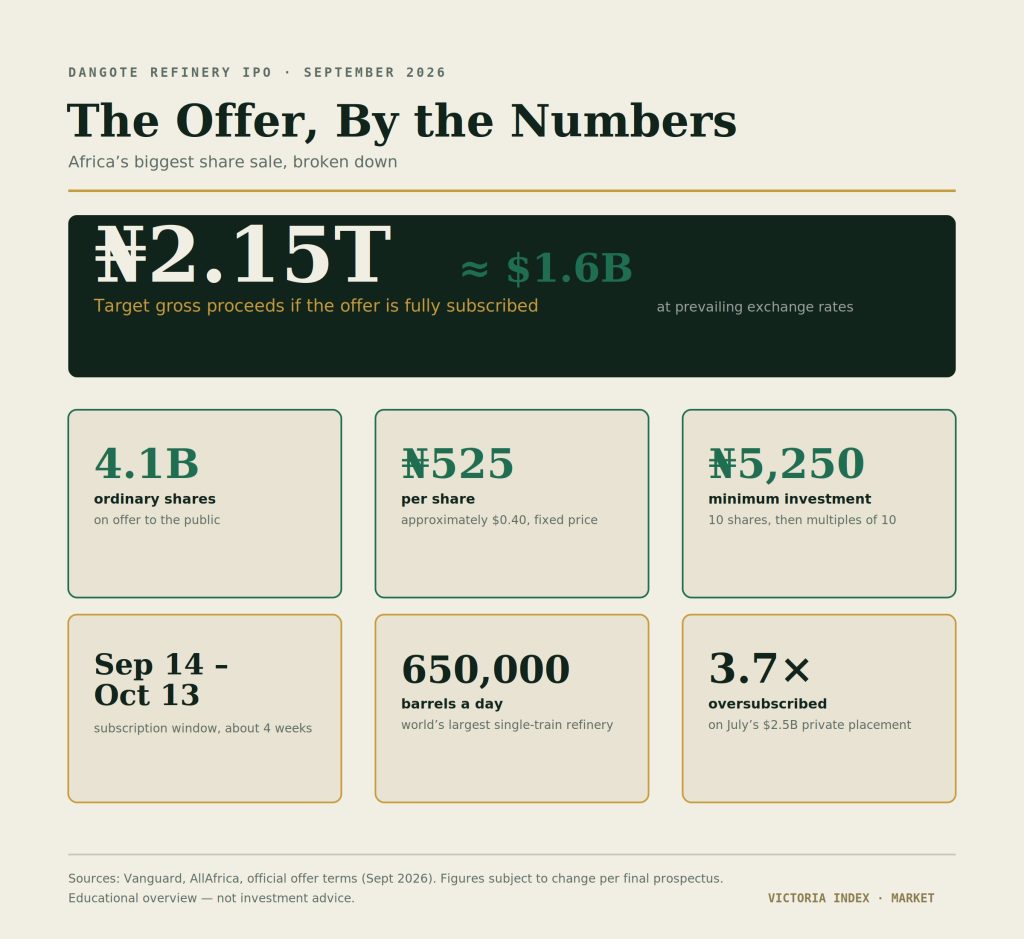
Infographic showing key Dangote Refinery IPO statistics — 4.1 billion shares, ₦525 per share, ₦2.15 trillion target raise, and minimum investment
₦2.15 trillion is on the table if Africa’s biggest-ever share sale is fully subscribed.
  • Shares on offer: 4,100,000,000 ordinary shares
  • Price per share: ₦525.00 (approximately $0.40)
  • Target offer size: ₦2,152,500,000,000 (roughly ₦2.15 trillion)
  • Minimum subscription: 10 shares, and multiples of 10 thereafter, meaning the smallest possible application costs ₦5,250
  • Payment terms: Full payment is due at the time of application; there’s no instalment option
  • Offer type: A fixed-price offer for subscription, not a book-build, so the price won’t move during the window
  • Oversubscription allowance: If demand exceeds the target, the issuer may absorb up to an additional 30% of the offer, subject to SEC approval
  • Retail incentive: Eligible retail investors who hold their allotted shares for a minimum required period may receive up to two bonus shares at no extra cost, subject to regulatory sign-off

According to Vanguard’s coverage of the signing ceremony, the offer was structured specifically to widen participation beyond institutional investors, with Vetiva Capital Management’s Group Managing Director describing the deal as designed for broad, transparent access rather than a narrowly institutional placement.
Timeline: Key Dates to Know

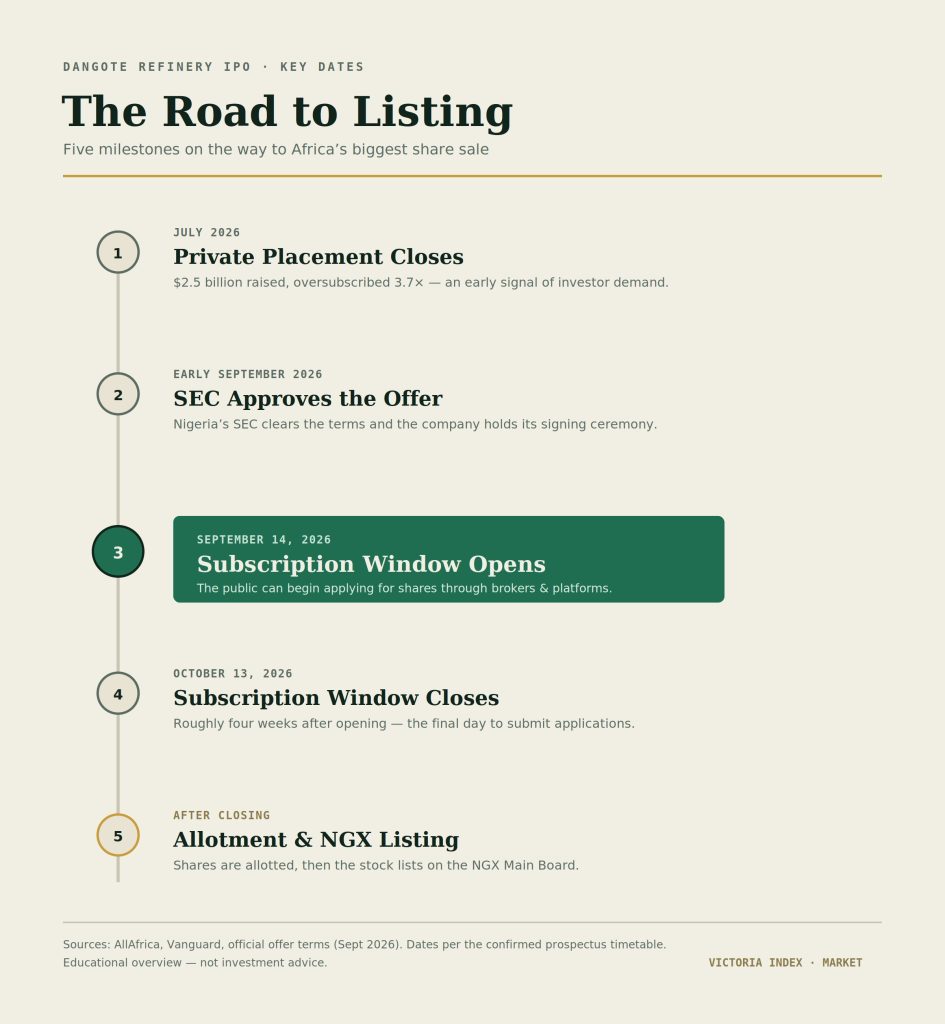
Timeline infographic showing five key Dangote Refinery IPO milestones from the July 2026 private placement to NGX listing
Five milestones, one countdown: the window opens September 14 and closes October 13.
DateMilestone
July 2026$2.5 billion private placement closes, oversubscribed 3.7 times
Early September 2026SEC approves the offer; terms and signing ceremony confirmed
September 14, 2026Public subscription window opens
October 13, 2026Subscription window closes (approximately four weeks)
After closingAllotment, followed by listing on the NGX Main Board

Proceeds from the offer are earmarked for growth capital expenditure at the refinery, according to the confirmed offer terms reported by AllAfrica, rather than being used to pay down existing debt.

How to Buy Shares

For readers who want to participate, the process runs through Nigeria’s standard capital markets infrastructure rather than any direct channel to Dangote itself:
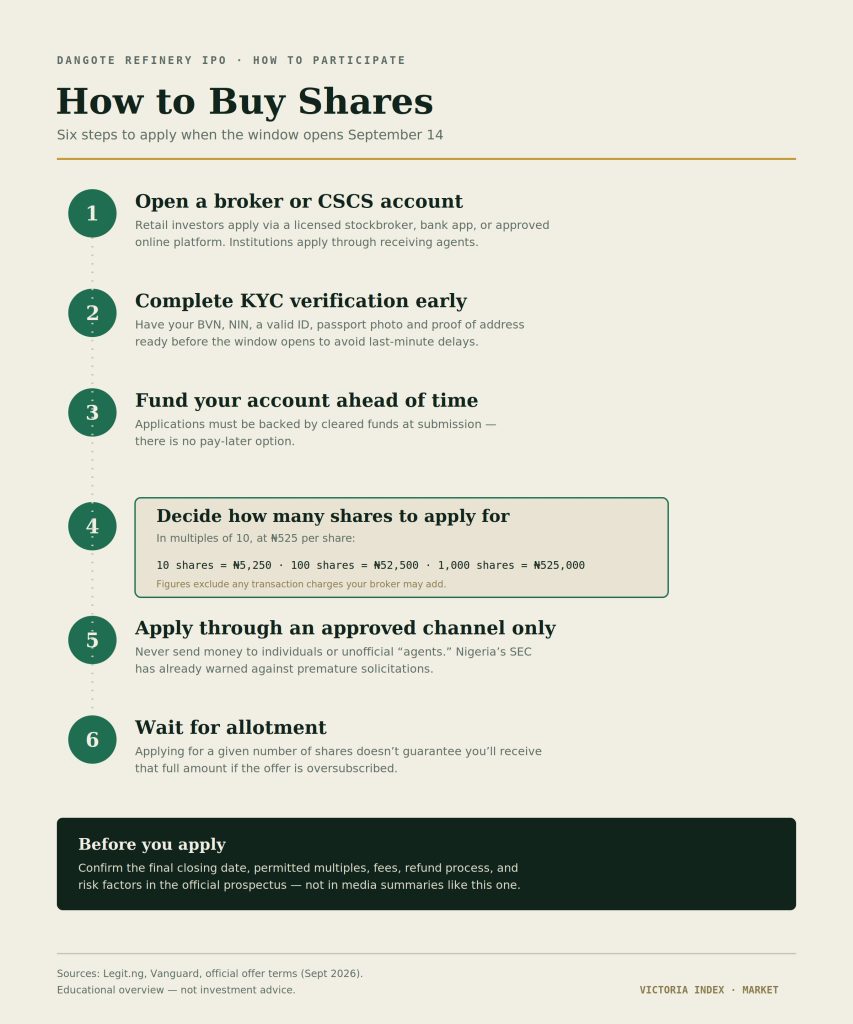
  1. Open or confirm a stockbroker or CSCS account. Retail investors can apply through a licensed stockbroker, participating bank apps, or approved online investment platforms. Institutional and other qualified investors apply through receiving agents using a formal application form.
  2. Complete KYC verification early. Most platforms will require a valid ID, your Bank Verification Number, National Identification Number, a passport photograph, and proof of address, according to Legit.ng’s step-by-step guide. Doing this before September 14 avoids delays once the window is live.
  3. Fund your account ahead of time. Applications must be backed by cleared funds at the time of submission; you can’t apply now and pay later.
  4. Decide how many shares to apply for, in multiples of 10. At ₦525 a share, ₦5,250 buys the minimum 10 shares, ₦52,500 buys 100, and ₦525,000 buys 1,000, before any transaction charges.
  5. Submit your application through an approved channel only. Never send money directly to individuals or unofficial “agents” claiming to represent the offer; Nigeria’s SEC has already warned the public against premature solicitations.
  6. Wait for allotment. Applying for a given number of shares doesn’t guarantee you’ll receive that full amount if the offer is oversubscribed.
Step-by-step infographic explaining how to apply for Dangote Refinery IPO shares, from opening a broker account to waiting for allotment
₦5,250 gets you in the door — here’s exactly how to apply.

Why This IPO Matters

The size here, both technically, and on the market, feels truly atypical of the Nigerian market. As I already wrote about the facility – 650,000 barrels of crude daily processed in what is arguably the world’s single largest crude refining train, Africa’s largest complex by refinery output capacity (it’s reached its full output capability as of February 2026). Raising 2.15 trillion successfully would be the largest ever offering on the NGX by value; and it is coming off strong demand from the 2.5 trillion private placement closed out in July, which was 3.7 times oversubscribed.

There’s a story beneath the numbers as well. Nigeria, the world’s seventh largest oil producer by country’s exports since 2001, has spent years importing the vast majority of its petroleum products, a dilemma the Dangote refinery was founded to overcome. Now opening access to ownership of that resource to retail investors, beyond institutional investors, falls part of the broader story that company owners have emphasized on the notion of diffusing benefits beyond the balance sheet.

Relative to where the rest of Nigerian shares are today, you can read our overview of NGX vs.

JSE that explains which mega-caps have driven much of the NGX performance so far in 2026 (and that Dangote could join shortly).

What Investors Should Still Confirm

A few things are worth checking against the official prospectus before applying, since early media coverage and the final offer documents don’t always agree on every detail:

  • The exact permitted application multiples and any transaction charges your broker or platform adds on top of the ₦525 share price
  • The company’s audited financials, dividend policy, and stated risk factors, all of which will be in the full prospectus rather than summarized in news coverage
  • Refund timelines if your application isn’t fully allotted
  • The confirmed post-offer listing date on the NGX Main Board, which follows the close of subscription rather than being fixed in advance

As with any equity investment, applying for IPO shares carries risk, and allocation isn’t guaranteed even if you apply in full. Readers who are newer to Nigerian equities may find it useful to first read our overview of the best banking stocks to buy during the recapitalization era and our roundup of Nigerian stocks to watch in 2026 for a sense of how the broader market has been pricing risk this year, and our explainer on how CBN policy affects your investments for the macro backdrop this listing is landing into.

This article is for informational purposes only and does not constitute investment advice. Share prices and allotments can vary, and readers should review the official prospectus and consult a licensed financial adviser before applying.


Related reading on Victoria Index:

For a broader explanation, we have a video from our VictoriaIndex TV that further explains this topic. Watch the video here and now.

Fafemi Godwin Uche
Fafemi Godwin Uche

Fafemi Godwin Uche is a financial and technology markets writer at Victoria Index. He holds a B.Sc. in economic geography and a master's in economics from the University of Ilorin and has 9 years of experience covering technology-sector earnings, fintech valuations, blue-chip stocks, and financial-market movements. He also writes on the wealthy, studying their lifestyle and how it impacts their wealth. His areas of interest include technology companies, technology stocks, blue-chip equities, the Nigerian capital market, and how low-class and middle-class Nigerians can grow wealth by emulating the lifestyle of wealthy individuals.

Before joining Victoria Index, he worked as an economic and stock market analyst at Ilorin.info, where he covered developments in Nigeria's economy and financial markets. At Victoria Index, he focuses on researching and explaining developments that affect companies, investors, and the broader financial market.

Areas of Coverage: Technology stocks, blue-chip equities, Nigerian stock market, corporate developments, financial markets, and investment education.

LinkedIn Page: https://www.linkedin.com/in/godwin-fafemi-uche-8b078921a/

Articles: 32