Physical Address
Victory Est, Ogombo Ajah, Eti-Osa, Lekki 101245, Lagos
Physical Address
Victory Est, Ogombo Ajah, Eti-Osa, Lekki 101245, Lagos

Nigeria Financial News, Stock Market Data, Economy & Market Analysis
Nigeria Financial News, Stock Market Data, Economy & Market Analysis

Market cap tells you how big a company is. Free float tells you how much of it you can actually buy.
Two of the most commonly referenced figures in Nigerian stock news reports are the market capitalization of the company and, even less commonly but increasingly so, the free float. Readers get to read headlines saying that the market capitalization of a bank “has crossed a trillion naira” and that the NGX All-Share Index has risen by so many percentages during a trading session. But very few people will go ahead to ask themselves what it really means and why a company is able to maintain a massive market capitalization yet the stocks don’t trade very much at all.
The concept of market capitalization, known as market cap, is just the product of a company’s stock price and the number of issued stocks. For instance, when a company has 2 billion issued stocks trading at ₦50 each, its market cap will be ₦100 billion. This is a representation of the collective market’s valuation of the company at a given point in time, neither its income nor profit or cash in the bank.
This concept of market cap is very important since it allows investors to easily distinguish between large-cap, mid-cap, and small-cap companies. However, market cap alone doesn’t provide any information regarding how many shares are available for a normal investor to purchase. There are companies that are large-cap companies yet hard to trade due to various reasons. This is where the concept of free float comes in handy.
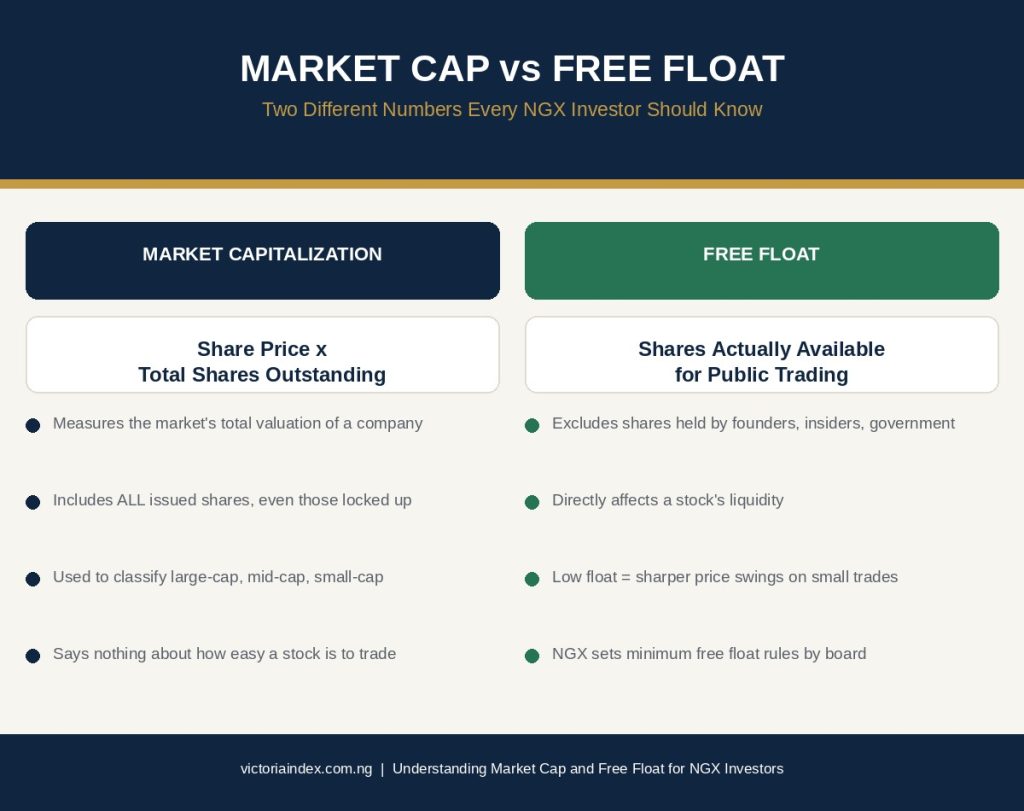
The free float, on the other hand, represents the number of outstanding shares that are traded publicly by the members of the investing public. This is the number of shares that exclude the shares held by the founders, promoters, government institutions, and any other party that does not trade actively. Two companies could be having the same market value but totally different free floats; the one may have 80 percent of its shares being traded by the public, while the other could be holding 80 percent of its shares with the founding family and only 20 percent free floating.
This aspect is crucial in terms of liquidity. The lower the free float, the lesser the shares that will be traded, thus making the price extremely volatile with minor transactions and making it difficult for institutional traders to establish or liquidate positions without having an adverse price movement.
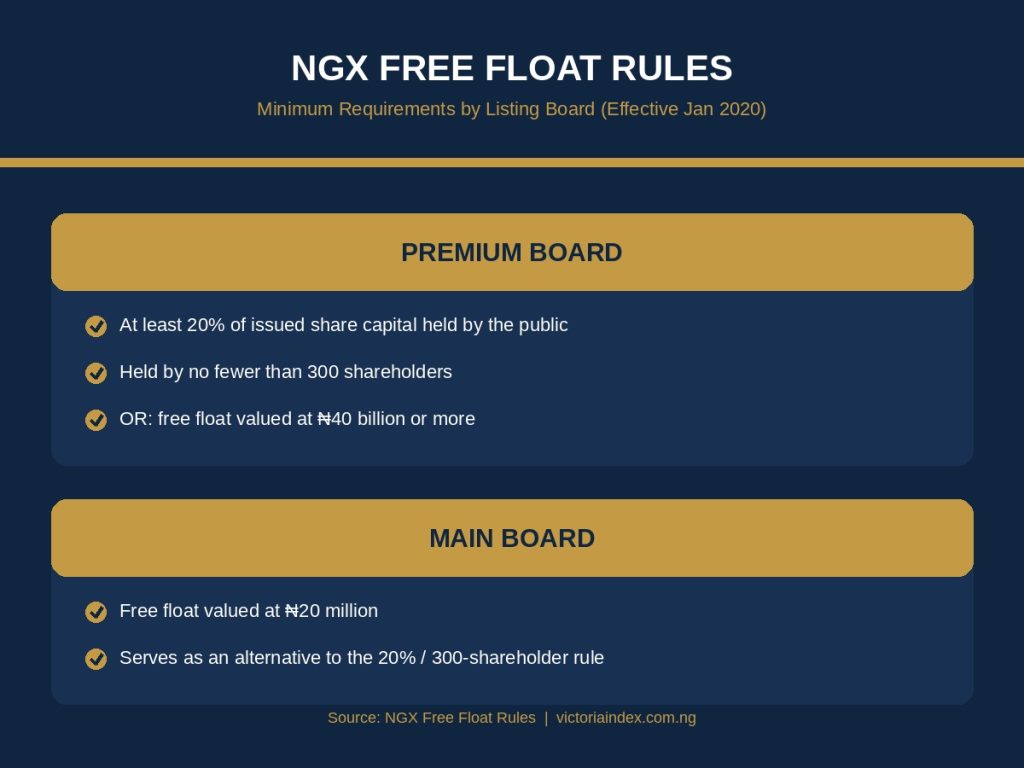
The Nigerian Exchange has minimum free float criteria for companies listed on its boards. These were set in January 2020. Premium Board companies are supposed to ensure that not less than 20% of the company’s issued share capital is freely floated in the market with not less than 300 shareholders holding the stock or alternatively ensure that the free float has a value of not less than ₦40 billion. The free float criterion for Main Board companies is much lower – ₦20 million serves as an alternative to the 20%/300-shareholder criterion.
The reasons behind the introduction of the above criterion are to prevent ordinary investors from being exposed to the risk associated with thinly traded securities that have a significant portion of share capital owned by insiders. These criteria are intended to ensure that NGX-listed stocks remain reasonably liquid. However, due to certain shortcomings in implementation, some issuers have been able to retain an unusually low level of free float.
The majority of the world’s stock indices, such as South Africa’s JSE and other emerging stock market indices, weigh their component stocks through free-float adjusted market capitalization instead of using total market capitalization. This practice gives more weight in the index to free floating stocks and less to stocks that cannot be easily traded. Traditionally, most NGX indices were constructed largely on the basis of total market capitalization, thus meaning a company that had a big but lowly liquid share capital could influence the movement of the index heavily.
This is changing. As per a March 2026 Nairametrics report, NGX officials have stated that NGX itself and the Securities and Exchange Commission in Nigeria are considering making free float a more integral part of NGX index construction and possibly moving toward weighting equities based on shares outstanding rather than market capitalization. One reason for this change is that the outside force in Nigeria is the fact that index construction firm MSCI has recently revised its global definition of free float early in 2026, thus leading to changes in portfolio weights in several emerging stock markets.
The bottom line for retail investors is that free float is now more than an academic point. The free float number is becoming more important as a reflection of how the exchange will itself compute and index its benchmarks.
When a stock’s price jumps sharply on what looks like modest trading volume, checking its free float is often more informative than checking its market cap. A stock with a small public float can be pushed up or down by a handful of large trades in a way a highly liquid, widely held stock simply can’t be. This matters directly for anyone building the kind of foundational understanding covered in Victoria Index’s breakdown of financial terms every Nigerian should understand, since market cap and free float sit right alongside terms like dividend yield and P/E ratio as basics worth knowing before placing a single trade.
Another thing that should not be overlooked is the fact that neither market capitalization nor free float tells anything about the fundamental value of the business. A firm may possess high market capitalization and strong free float and still be a bad investment if it has poor fundamentals. All these statistics simply show the tradability of the security, but do not reflect on its investment value, which is where good investors differ from speculators.
A few habits are worth building around these two concepts:
For a full breakdown of the current free float requirements by board, NGX’s own investor resources and the Central Securities Clearing System are worth bookmarking directly, since both publish the technical detail behind how shares are registered, cleared, and tracked once they change hands.
The market capitalization gives an indication of the size of the firm in terms of market perception while free float gives us an idea about how much of that firm can be owned if someone tries to buy it. Both indicators are important and analyzing NGX stocks without both of them means missing out on something very essential.