Physical Address
Victory Est, Ogombo Ajah, Eti-Osa, Lekki 101245, Lagos
Physical Address
Victory Est, Ogombo Ajah, Eti-Osa, Lekki 101245, Lagos
Nigeria Financial News, Stock Market Data, Economy & Market Analysis
Nigeria Financial News, Stock Market Data, Economy & Market Analysis
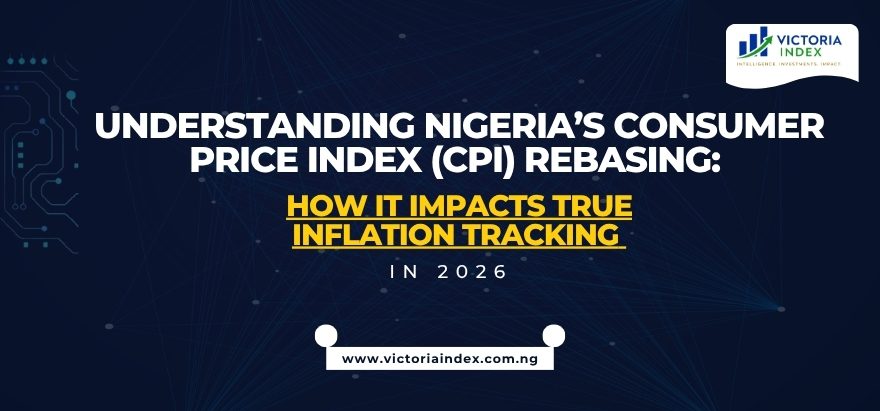
To many of us who traverse the markets in Lagos, Kano, and Port Harcourt, the figures provided by the government often seem out of sync with our own experiences of economic activity. You step into a market stall, you see what the cost of a bag of rice is or transport fares, and you question whether the government’s figures are looking at the same economy that you’re seeing. It has been the topic of discussion over this year in connection with rebasing Nigeria’s Consumer Price Index (CPI). If you have ever wondered about the reason behind the new figures or the way prices will be tracked in 2026, then you have come to the right place.
Consider the economy to be just like a building that has undergone a major renovation, but we still are measuring its rooms using the old floor plan. This is almost similar to the way the inflation had been measured in the past. The fact is that for years, we have been using a set of goods and services consumed by people back in 2009 to track the inflation rate. But honestly speaking, our life today in 2026 is completely different from how it was some 20 years ago.
According to Agusto & Co., it is the National Bureau of Statistics (NBS) which performed this trick to keep the economic mirrors up-to-date. This is being done by adjusting the “weight” of our purchases—decreasing the share of goods that we purchase occasionally and increasing the share of new services like telecommunications and logistics.
By re-basing we mean a revision of the base period against which all the future changes will be calculated. Now the new index will employ 2024 as the base period and 2023 weights. Such step was vital in terms of taking into consideration the development of the inflation trend in Nigeria in 2026.
The basket of goods and services now has 934 product types compared to the more limited basket before. It includes 13 groups of products in accordance with the international COICOP 2018 classification. In my opinion, this is a breath of fresh air since subscription costs, refined fuel prices, and other factors such as dynamic changes in the transport sector will be accounted for properly in calculations.
Nevertheless, there is one problem. Any time you re-base, you introduce a break in the data, thus it is impossible to compare the rate of inflation in 2024 with the rate in 2026.
At the bus stops and in the office water coolers, people continue to ask this question: “Why does the market price list remain so high even if the data shows that inflation has been reduced?”
It is important to note that the “reduction” seen in the figures after the rebasing exercise was not an indication of price reduction but just a reflection of the re-valuation of certain costs using the new methodology. The new methodology re-calibrated the “weight” allocated to items whose prices were rising, hence reducing the figure in percentage terms.
For those who wish to have a better understanding of how the figures in this context are computed, the National Bureau of Statistics provides breakdowns of such divisions. However, one must be clear on whether what they are looking for is just a statistical adjustment and not purchasing power relief. Even in 2026, when the headline figure shows a trend of stabilization as opposed to the previous years, Nigeria cost of living 2026 remains challenging.
But in addition to the headline figure, we all experience the volatility of the Nigerian market price. Even in spite of the “tamer” figures of the CPI, we experience high volatility of the prices on the food products and the energy sources. New inflation indicator is aimed to reflect it, but being reflected isn’t equivalent to being solved.
Being a consumer, I would like to focus on such sub-indices as “Core Inflation” and “Food Inflation”. They provide much more precise picture in comparison with the head line. For instance, if the prices for energy sources increase, they are going to influence not only the electricity bill, but the cost of transportation of each food product from producer to consumer. Such “pass through” effect allows me to make an adequate budget of the month.
If you are trying to make sense of your personal finance, don’t get too caught up in the decimal points of the national headline rate. Instead, look at the divisional reports.
Food and Non-Alcoholic Beverages: These remain a massive component of our spending.
Transport Services: With the shift in fuel subsidies and energy dynamics, this division is more volatile than ever.
Services and Technology: Because the new index now captures more of our digital lifestyle, you might notice that inflation in these areas actually feels closer to your daily experience.
It is important to cease thinking of the CPI as something that accurately portrays the situation in our own pockets. This is an aggregated index. It may portray the “average” Nigerian, but we are not average. Our inflation rates will differ according to whether we use public transportation or not, the proportion of our income spent on rent or food, and even which part of Nigeria we come from. This is according to experts at the Research and Policy Center (RPC).
What lies ahead? As recent reports suggest, external analysts are closely monitoring these indices. Although the rebasing will give us an improved instrument to look into the future, the structural factors – such as infrastructure deficiencies and supply chain disruptions – continue to be the primary factors behind inflation.
The employment of NBS economic data analysis by the government is a move towards more transparency, but for the rest of us, it is important to stay resilient. Once we realize that the CPI is simply one of the tools in our large kit, we will no longer be surprised by discrepancies between the numbers and our shopping experiences.
It was essential to rebase the Nigerian Consumer Price Index (CPI) and get a new perspective of Nigeria’s economy because an old index does not reflect modern realities. Though it will be confusing in terms of comparing the economy in different times, the new CPI will be a tool to look at the future development of our country.
Throughout 2026, do not forget about watching statistics and adjusting your budget according to it. However, never ignore what you see yourself in the market. Figures speak about reality, but you live that reality.