Physical Address
Victory Est, Ogombo Ajah, Eti-Osa, Lekki 101245, Lagos
Physical Address
Victory Est, Ogombo Ajah, Eti-Osa, Lekki 101245, Lagos
Nigeria Financial News, Stock Market Data, Economy & Market Analysis
Nigeria Financial News, Stock Market Data, Economy & Market Analysis
Ten practical investment options for young Nigerians in the AI era, from treasury bills to equity crowdfunding, with real platforms.
The environment into which these young Nigerians have entered in terms of investment is vastly different compared to what existed when their parents were entering the same environment. The value of naira savings continues to dwindle due to inflation, global career trends continue to change much more rapidly than before, and artificial intelligence is integrated into every aspect of the technology that young people can use to invest, such as the anti-fraud measures employed by banks and the robo advisors managing investment portfolios on their own in the background.
Here is a list that discusses ten different investment opportunities that should be considered based on actual realities rather than hype.
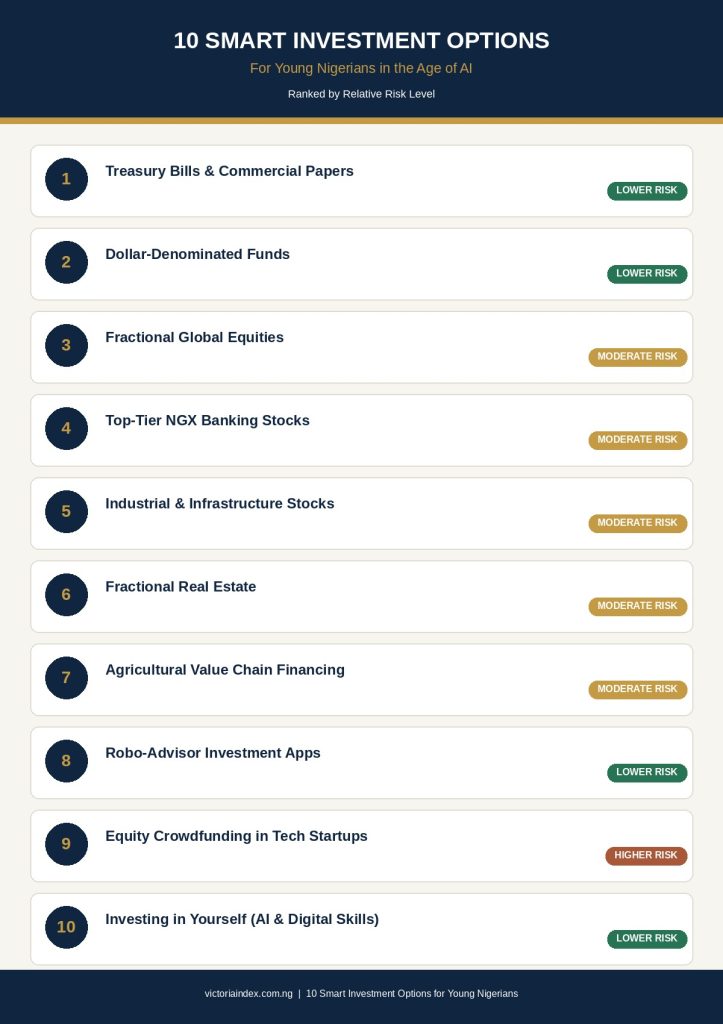
Government-backed debt instruments remain one of the lowest-risk ways to earn a real return in Naira. Treasury bills and short-term commercial papers offer predictable, often double-digit yields with minimal default risk, and several fintech apps now send alerts when auction rates move, making it easier to time when to roll over maturing capital. For anyone just starting out, this is usually the right foundation to build on before moving into riskier assets, a point covered in more depth in Victoria Index’s guide on how to save money effectively in Nigeria.
Holding everything in Naira leaves a portfolio fully exposed to currency depreciation. Eurobonds and dollar-denominated mutual funds, offered through platforms like Cowrywise, give investors a way to hold part of their savings in a more stable currency without needing to open a foreign brokerage account directly. This isn’t about abandoning Naira assets entirely; it’s about not keeping all of one’s savings exposed to a single currency’s swings.
Buying shares of large international companies used to be an inaccessible opportunity for most Nigerian retail investors. Digital brokerages have made it possible for retail investors to buy fractions of international equities, including the technology firms which are at the forefront of the AI revolution. This is one of the most direct ways of taking advantage of the opportunities being presented by artificial intelligence for those that wish to engage with the phenomenon beyond using it as a tool.
Nigeria’s banking sector tends to perform well during periods of high interest rates, since wider margins between what banks pay depositors and what they earn on loans directly boosts profitability. Established names with strong governance and liquidity tend to weather macroeconomic cycles better than smaller players, which is part of why they remain a core holding for many long-term NGX portfolios. Current pricing and trading data can be tracked directly through the NGX Group’s official market data portal, rather than relying on secondhand commentary.
Companies engaged in the production of cement, steel, and other critical construction materials possess pricing power due to the persistent demand for infrastructure in Nigeria, and their ability to pass through higher input costs to customers while retaining market share, which protects their margins during inflationary periods better than industries with narrow competitive moats.
Land and property have always been a popular source of wealth in Lagos and Abuja, but the high initial cost has prevented many young investors from participating. Fractional real estate crowdfunding platforms solve that by allowing multiple investors to come together and purchase commercial or residential property, with profits from the rent divided accordingly. However, due to the novelty of the space, a potential investor should be wary when entering the market and thoroughly research the experience and reputation of the platform.
Precision farming, satellite monitoring of crops and the use of predictive analytics for weather patterns are starting to reshape agricultural investment in Nigeria. Crowdfunded farming platforms are using this data to monitor and de-risk the lifecycle of a crop or livestock investment, providing more transparency on where funds are being allocated than ever possible before in the space.
For investors who don’t have the time or interest to research individual tickers and bonds, robo-advisors handle asset allocation automatically based on a stated risk profile, adjusting the mix of local and international assets and rebalancing over time without manual intervention. This is genuinely one of the clearest examples of AI making investing more accessible rather than more complicated, though it’s worth remembering that a robo-advisor is only as good as the assumptions built into it, and it doesn’t replace understanding what’s actually inside a portfolio.
For investors comfortable with higher risk, platforms like GetEquity allow direct participation in early-stage funding rounds for African tech startups. Because many of these businesses operate with lean, tech-driven models, the potential upside over a five-to-ten-year horizon can be substantial, but so is the failure rate among early-stage companies generally. This category belongs at the smaller, higher-risk end of a portfolio, not the core of it.
The most overlooked investment on this list is often the most valuable one. Building competency in data analysis, AI-adjacent tools, or other globally competitive digital skills creates ongoing active income that can fund every other investment on this list. A stronger skill set also tends to be the fastest way to increase the actual capital available to invest in the first place, which matters more than optimizing any single asset choice.
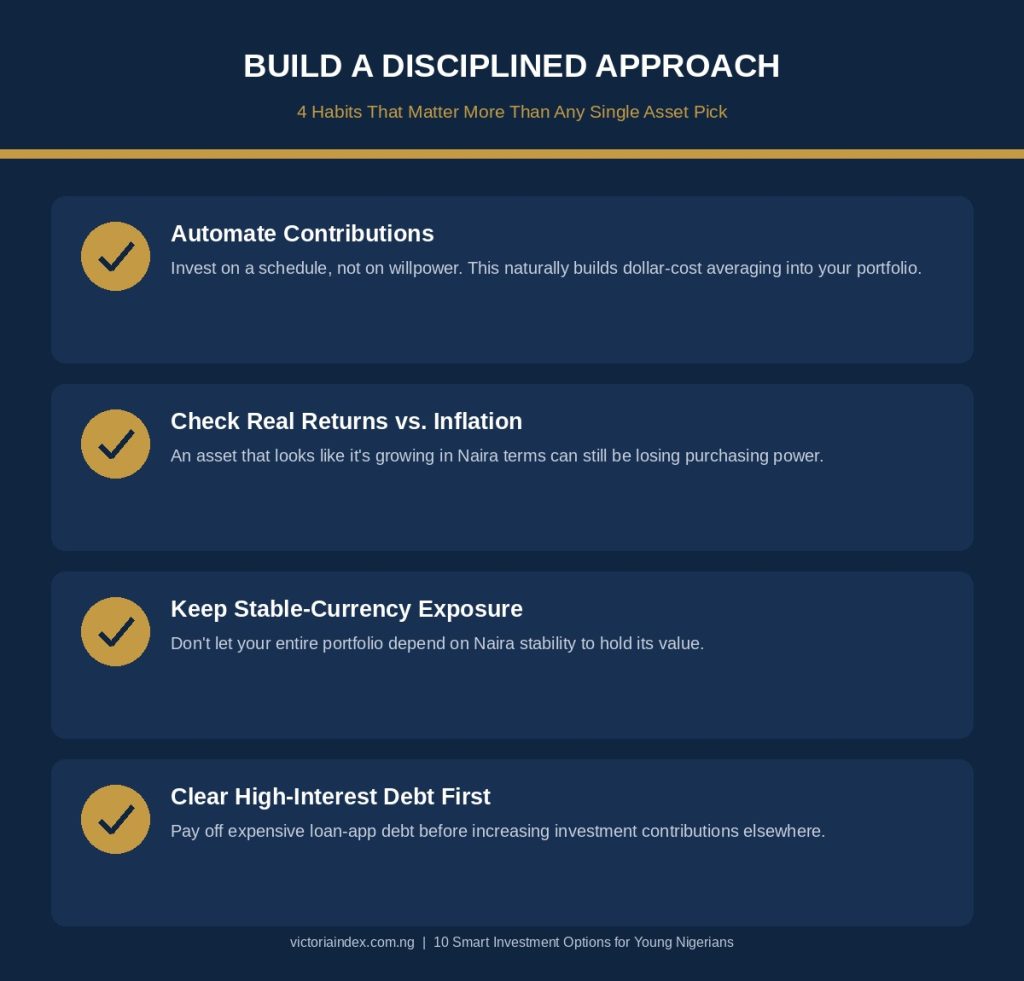
None of these options work well without some structure behind them. A few habits worth adopting:
For young Nigerians building a long-term financial base, the specific asset mix matters less than the discipline behind it. AI-powered tools have made access easier and information faster to find, but they haven’t changed the basics: understand what’s being bought, diversify deliberately, and let time and consistency do most of the work. For readers just starting to build that foundation, Victoria Index’s guide to retirement planning for self-employed Nigerians is a useful next read, since long-term investing and retirement planning are really the same habit applied over different time horizons.