Physical Address
Victory Est, Ogombo Ajah, Eti-Osa, Lekki 101245, Lagos
Physical Address
Victory Est, Ogombo Ajah, Eti-Osa, Lekki 101245, Lagos

Nigeria Financial News, Stock Market Data, Economy & Market Analysis
Nigeria Financial News, Stock Market Data, Economy & Market Analysis
Nigeria's debt hit N159.35 trillion in 2026. Here's how domestic and external borrowing differ, and why the split actually matters.
The national public debt in Nigeria has exceeded N159.35 trillion up to March 2026, according to the Debt Management Office. However, for many people, the figure in question does not really provide any significant information. It is important to know not only the overall size of the national debt but also the composition of the national debt, including the proportion of domestic and foreign debts, their cost to the state, and the reason why it is important to balance between the two, influencing the exchange rate of the Nigerian currency and budget freedom.
This is not only a topic of debate among economists, because financing of the debt reduces the funds available to the government for other purposes such as construction of infrastructure, development of the health sector, and subsidization, and financing the debt also impacts the interest rate, the inflation rate, and the investing environment of ordinary investors.
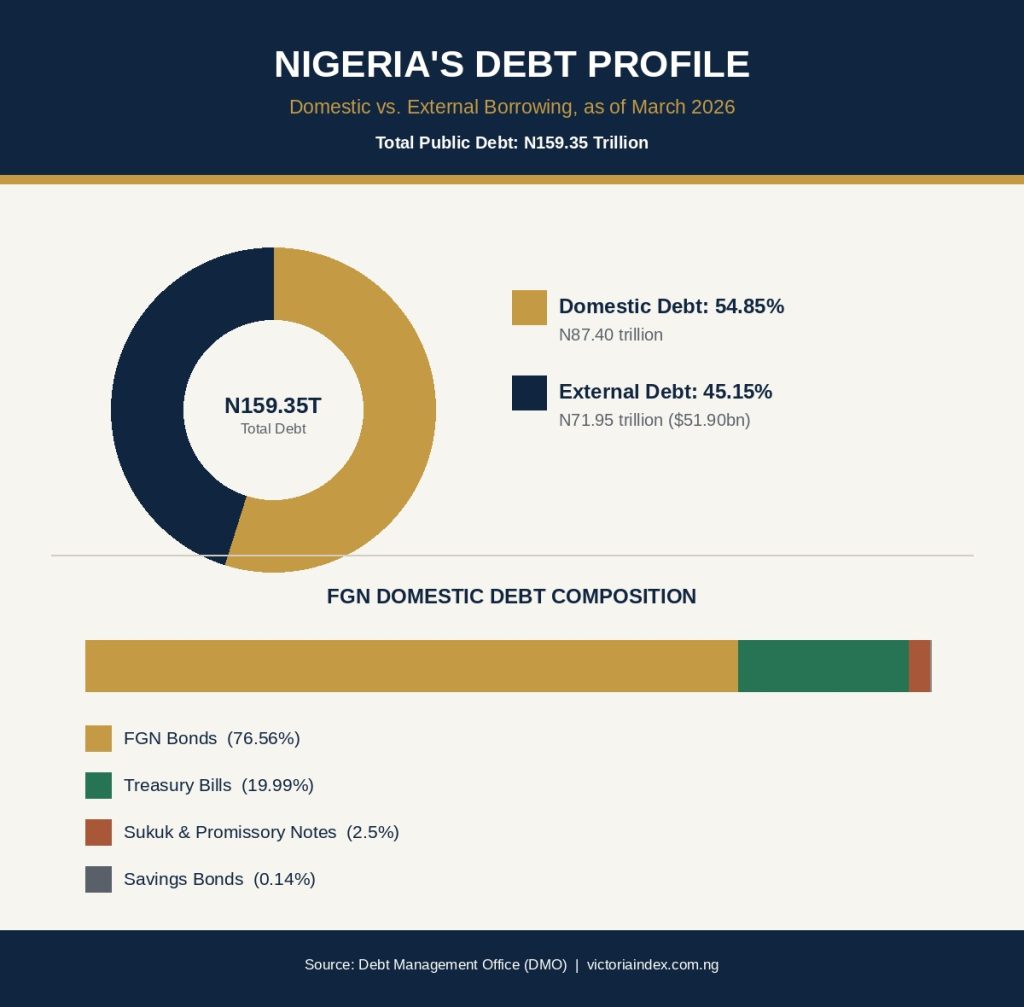
According to the most recent data of the DMO, domestic debt represents 54.85% of the overall public debt of Nigeria worth approximately N87.40 trillion, while the rest 45.15% of the public debt is external debt worth approximately N71.95 trillion or $51.90 billion. This represents an important difference compared to the previous year, when the domestic debt represented 52.72% of the overall debt. The increase in domestic borrowing in recent times by Nigeria is deliberate.
Domestic debt is money the federal and state governments borrow from lenders within Nigeria, primarily through instruments issued and tracked by the DMO. FGN Bonds make up the largest single component of this, at N63.45 trillion, followed by Nigerian Treasury Bills at N16.57 trillion. Smaller pieces include FGN Sukuk (N1.19 trillion), Promissory Notes (N1.39 trillion), and FGN Savings Bonds (N116.21 billion), the retail-friendly instrument Victoria Index has covered separately for individual investors looking to lend to the government directly.
External debt is money owed to lenders outside Nigeria, split across multilateral institutions (like the World Bank’s International Development Association), bilateral creditors (other governments), and commercial sources like Eurobonds. This is the debt that’s denominated in foreign currency, which is exactly why exchange rate movements matter so much to Nigeria’s fiscal position: when the Naira weakens, the naira-value of existing dollar-denominated debt rises even if the dollar amount owed hasn’t changed at all.
This is where the domestic versus foreign debt classification ceases to be merely technical and becomes a reality. Repayment of domestic debt is done in Naira, so a depreciation of the currency does not automatically increase the value of debts in the local currency despite an increase in cost of servicing newly incurred loans. However, this cannot be said about external debt; since it is expressed in dollars or any other foreign currency, each point of depreciation of the local currency results in increased cost of servicing that same debt in the local currency despite no increase in the government’s borrowing in foreign currency.
That was exactly how things developed during the two years under review. The country’s external debt increased from $45.98 billion in March 2025 to $51.90 billion in March 2026, an increase of nearly $6 billion in dollar terms. In the local currency, however, the same debt increased by a relatively modest 1.87% due to the fact that the exchange rate used for calculation had strengthened during this time. Therefore, a stronger Naira indirectly decreased the burden of servicing Nigeria’s external obligations in the local currency – one of the reasons why currency stability is just as important as inflation control for a fiscally sustainable future.
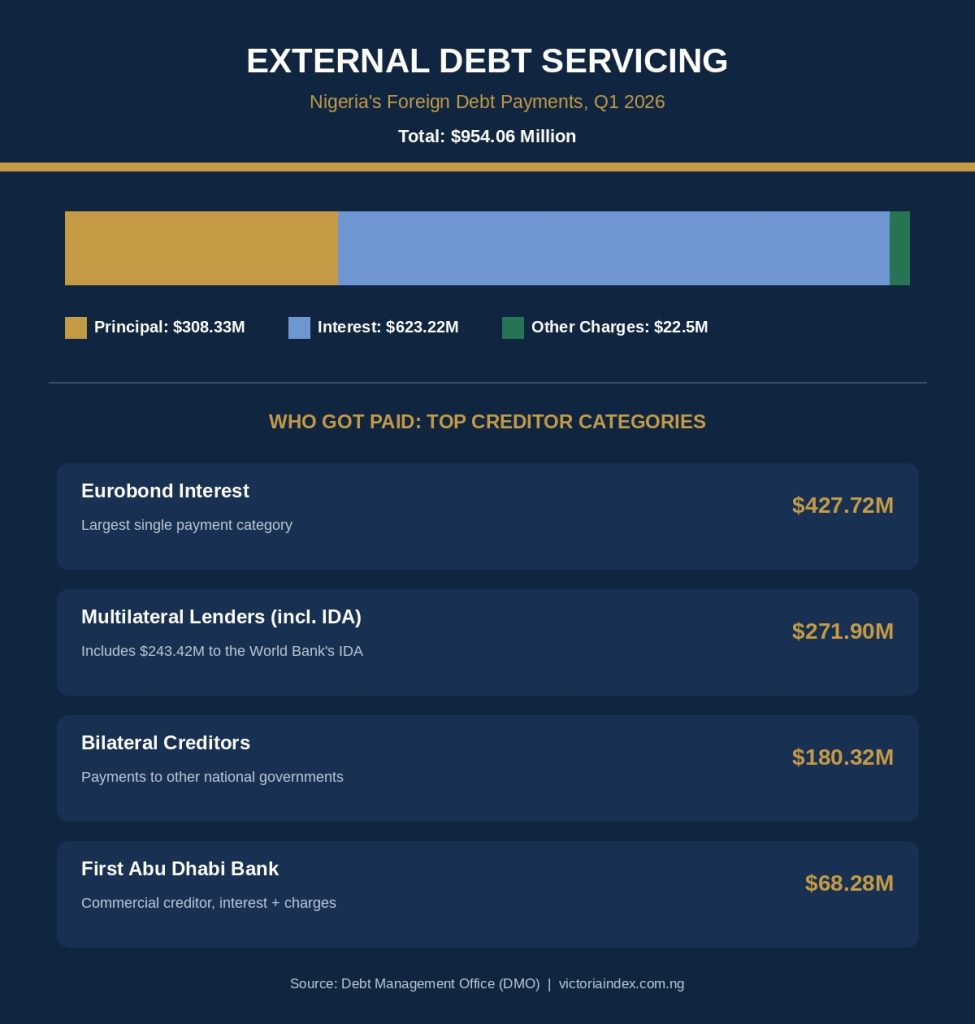
Debt servicing, the interest and principal payments a government makes on what it owes, is where the two debt types diverge again. Nigeria spent $954.06 million servicing its external debt in the first quarter of 2026 alone, according to DMO figures, made up of $308.33 million in principal repayments and $623.22 million in interest. Eurobond interest payments accounted for the largest single chunk of that, at $427.72 million, more than any other creditor category. Multilateral lenders, including the International Development Association, received a comparatively smaller $271.90 million over the same quarter.
That external service bill actually declined by 31.5% compared to the same period in 2025, driven mainly by a smaller principal repayment obligation this year rather than any dramatic change in interest costs. Domestic debt servicing tends to move differently, tracking the Central Bank’s benchmark interest rate more directly, since FGN Bonds and Treasury Bill yields are priced off that rate. When the CBN keeps rates high to manage inflation, as covered in Victoria Index’s breakdown of how CBN policies affect your money and investments, the government’s own domestic borrowing costs rise right alongside everyone else’s.
The move towards domestic debt in the last year was not a coincidence. By using local loans, the government manages to avoid any new foreign currency exposure while trying to stabilize its currency in a situation where for several years it has been very volatile. Also, such loans help to pay off debt in the currency that can be printed theoretically by the government in case of need, although there would be a risk of inflation. The loans from local sources are needed because it is necessary to invest in pension funds and banks where there is a need to save money, and therefore it explains why the FGN Bonds constitute the biggest part of the debt composition.
The downside of it is that the increase of domestic debt may cause the limitation of private sector loans. The reason is simple: banks with many government securities have less opportunity and even less willingness to provide cheap loans for entrepreneurs. One of the reasons for such behavior is explained in more details by Victoria Index in her analysis of the cost of credit in Nigeria.
Whether Nigeria’s inflation trajectory continues to ease, a question Victoria Index examined directly in its analysis of whether inflation will drop in Nigeria in 2026, has a direct bearing on the debt conversation too. Lower inflation generally gives the CBN room to ease interest rates, which would reduce the government’s own domestic borrowing costs and, by extension, ease pressure on the federal budget. A stronger, more stable Naira similarly reduces the local-currency weight of external obligations, as the past year’s numbers already show.
But all of this does not imply that Nigeria is free from risks in terms of its debt levels. With the continued rise of the debt to GDP ratio, along with the persistently high debt service to revenue ratio, Nigeria’s government faces constraints in terms of its fiscal space for anything beyond servicing its debts. However, analyzing the split between internal and external debt in contrast to merely reacting to one large number will certainly provide a much better insight into the true risk areas.
For readers who want to track this directly, the Debt Management Office’s public debt reports are published quarterly and remain the most authoritative primary source on Nigeria’s debt composition, while outlets like Nairametrics regularly break down what each new release actually means in practice.