Physical Address
Victory Est, Ogombo Ajah, Eti-Osa, Lekki 101245, Lagos
Physical Address
Victory Est, Ogombo Ajah, Eti-Osa, Lekki 101245, Lagos
Nigeria Financial News, Stock Market Data, Economy & Market Analysis
Nigeria Financial News, Stock Market Data, Economy & Market Analysis
VictoriaIndex breaks down the 2026 NGX rally, what fueled it, June's pullback, and whether Nigeria's stock market can hold its gains.
Nigeria’s equity market recorded one of the best first-half performance in recent times in 2026 as the Nigerian Exchange (NGX) All-Share Index (ASI) climbed by 47.43 per cent to close at 229,419.18 points on 30 June 2026, up from 155,613.03 points as of 31 December 2025. Similarly, the NGX market cap also rose by about ₦47.84 trillion to ₦147.22 trillion as of 30 June 2026. Proshare’s H1 2026 NGX review had shown.
With such a spectacular gain in the first half of the year, the most pressing question facing investors now is: Will the NGX continue to rise in the second half or is another correction coming soon?
That will be determined by earnings, valuations, liquidity, oil prices and election politics as Nigeria gears towards the 2027 general elections.
The numbers speak for themselves.
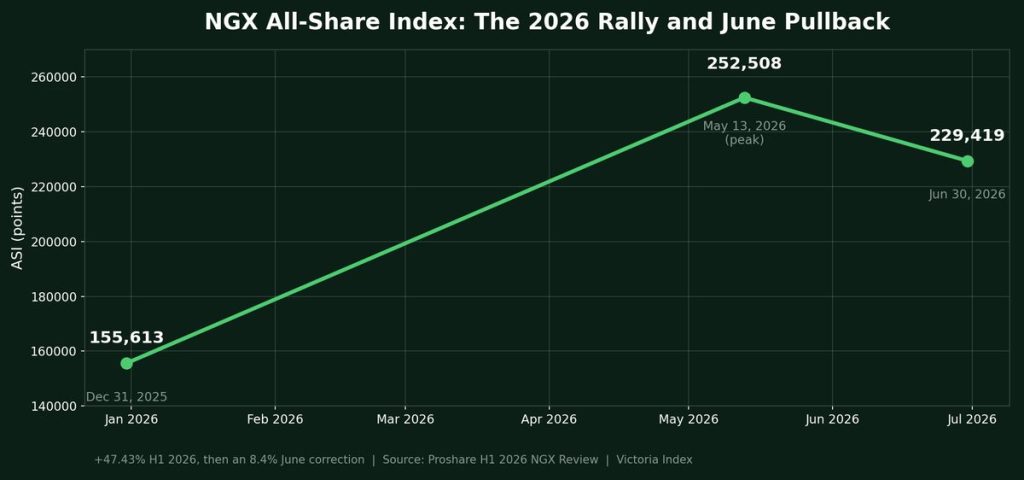
Having risen by 29.35 per cent in Q1 2026, the NGX ASI recorded a mammoth 47.43 per cent rise between January and June, hitting a peak of about 252,508 points on 13 May before embarking on the correction that began in June. The market cap followed a similar pattern, rising from about ₦99.38 trillion as of 31 December 2025 to ₦147.22 trillion by the end of June, a tidy gain of about ₦47.84 trillion. It is important to note that the changes in market value are not necessarily reflective of cash proceeds as market value is purely a function of share prices.
That said, the scale of the gains is quite astonishing. An investor who bought shares worth ₦100 in the NGX at the start of 2026, for example, would have been able to sell the same shares for about ₦147.43 by the end of June, a tidy gain of ₦47.43 on the initial investment. Bank recapitalisation was one of the key drivers of the 2026 NGX rally
One of the key factors that drove the market to record heights in 2026 was the capital market’s role in financing Nigeria’s banking sector recapitalisation programme. The Central Bank of Nigeria (CBN) recently issued new guidelines on minimum capital requirements for banks, with the new guidelines taking effect from 1 April 2026. According to the Securities and Exchange Commission’s official website, under the new guidelines, banks had until 31 March 2026 to meet the requirements. The capital market played a significant role in the recapitalisation drive, with a total of about ₦4.65 trillion raised on the exchange.
The new guidelines sent shockwaves throughout the market as investors bid up the shares of banks that participated in the offering. It also spurred speculation about which banks would emerge stronger and more resilient following the capital overhauling of the sector. Victoria Index previously examined the process in its analysis of Nigeria’s banking recapitalisation race.
While the recapitalisation drive benefited the banks that participated in it, it also created a ripple effect that drove the broader NGX to record highs.
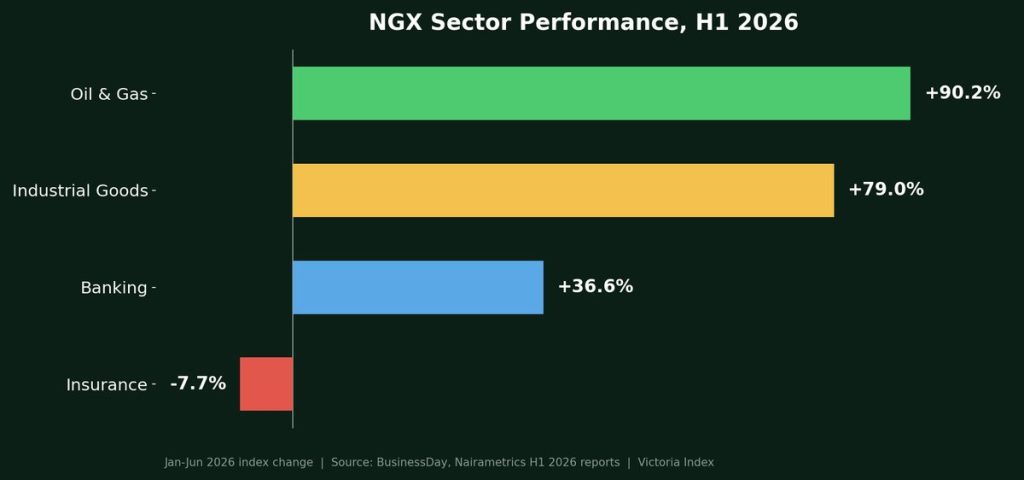
The NGX Oil and Gas Index was the talk of the NGX in H1 2026 as it soared by about 90.2 per cent to close at 99,558.88 points in comparison to 52,358.33 points as of 31 December 2025. In a review of BusinessDay’s H1 oil and gas sector performance, the shares of Seplat Energy and Aradel Holdings were among the major gainers as investors continue to do business in the Nigerian energy sector.
Indeed, oil and gas stocks had a stellar year in 2026 with robust demand for their shares as investors anticipated bountiful dividends and profits from the sector. With that said, the stellar performance of the oil and gas sector creates challenges for the second half of the year as many stocks in this space will need to deliver even better returns to justify their lofty valuations. Industrial goods, banks also shine in 2026
The NGX Industrial Goods Index was another star performer in 2026, rising by about 79 per cent to close at 34,450.04 points in comparison to 19,201.01 points as of 31 December 2025. A comparison by Nairametrics confirmed that the NGX Industrial Goods Index rose on the back of increased demand for the shares of cement companies as investors anticipated a surge in demand for construction materials following the need for new infrastructure. The banking index also rose strongly by about 36.6 per cent to close at 66,954.19 points in comparison to 48,894.89 points as of the end of 2025.
The NGX Insurance Index, on the other hand, was the only sector that finished the first half of 2026 in negative territory as it dropped by about 7.7 per cent to close at 3,223.08 points in comparison to 3,472.64 points as of year-end 2025.
The performance of the NGX Insurance Index illustrates the fact that not all stocks are created equal and that while the NGX as a whole may be on a tear, individual stocks and sectors can lag significantly.
The NGX correction that commenced in June 2026 was precipitated by rampant profit-taking as the market had climbed to dizzy heights in the first five months of the year. The ASI, for example, dropped by about 8.4 per cent in June to close at 229,419.18 points, down from 252,508.03 on 13 May. Market cap also dropped from about ₦160.51 trillion as of 31 May to ₦147.22 trillion by the end of June. Victoria Index’s Nigerian capital market recap
The sell-off in June was largely a profit-taking exercise by investors who had recorded spectacular gains in the first half of the year. In addition, the yields on fixed income securities continue to lure investors away from the stock market. In particular, the yield curve of treasury bills makes them quite attractive to investors who crave stability as the Central Bank of Nigeria routinely announces the yields. Victoria Index’s guide to Nigerian Treasury bills explains how these instruments work.
Therefore, while the sell-off in June may be viewed as a sign that the bull run in the Nigerian capital market is over, it really isn’t. The correction merely signifies that some investors are locking profits following the spectacular gains recorded in H1 2026.
The primary test for the NGX bulls will be the ability of listed firms to report better earnings as valuations continue to climb. For instance, after recording a stunning 47.43 per cent rise in the ASI in H1 2026, investors will be much more selective in their investments as they look to protect their hard-earned money. As such, well-established firms that report consistent earnings and dividends will benefit from the sell-off in some sectors as investors look to shift their investments to firms with sustainable earnings and dividends.
The central bank’s interest rate policy will also play a critical role in determining where the NGX goes from here. The CBN kept the Monetary Policy Rate (MPR) at 26.5 per cent in February 2026 after lowering it to the same level in January of this year. The level of benchmark interest rates will have an impact on the relative attractiveness of fixed income securities and shares. If the yields on government securities are high, investors may be tempted to shift some of their investments to fixed income securities.
The stellar performance of the oil and gas sector in 2026 will also be a key determinant of where the NGX goes from here. The strong profits and dividends reported by firms in this sector will propel the index higher in the years ahead. However, a disappointing performance from the sector, as well as lower oil prices, will result in heavy profit-taking and a bearish sentiment for the market.
The looming general elections in 2027 will also be a key determinant of the direction of the NGX in the second half of this year and beyond. The increased political noise in Nigeria will see investors scrutinising public spending, fiscal policies, economic reforms, and the stability of the Naira. Victoria Index’s analysis of foreign portfolio investment in the NGX provides additional context on the role international investors play in the market.
There are a number of factors that will determine the trajectory of the NGX. For the bulls, the recapitalisation of the banking sector has ensured that the sector’s fundamentals are on a solid footing. This has been demonstrated by the ₦4.65 trillion raised by the banks on the capital market as part of the recapitalisation drive. Strong performance in the oil and gas and industrial goods sectors will also benefit the NGX as investors continue to buy shares in firms that play a key role in Nigeria’s energy and development needs.
The main reason why the NGX is likely to experience a bear run in the near term is due to the sheer scale of profits recorded by investors in H1 2026. In the wake of the selloff in June, investors who had bought shares at the beginning of the year will be looking to cash in their profits and shift some of their investments to other asset classes. Indeed, it might not be long before investors begin to question if the NGX is a viable long-term investment option.
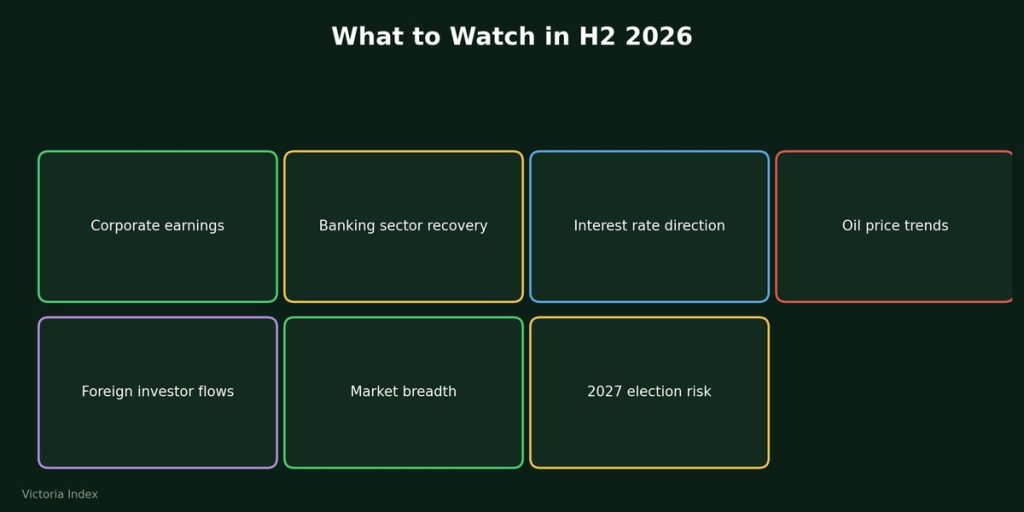
Here are some of the critical indicators for investors to watch out for in the weeks and months ahead:
The market breadth and the movements in the aforementioned indicators will be more important than the gains recorded by the All-Share Index. Indeed, the next phase of the NGX bull run will be dictated by corporate performance and the dynamics of the broader economy.
The 2026 NGX rally has lived up to expectations as one of the best first-half performance in the memory of Nigerian capital market investors. The ASI, for instance, recorded a staggering 47.43 per cent gains from January to June, with the market valuation also surging by about ₦47.84 trillion to ₦147.22 trillion. Oil and gas stocks surged, with industrial goods also posting sizeable gains. In addition, the banks benefited from the recapitalisation drive. However, investors should also keep in mind that the second half will be a much tougher ride as the market’s lofty valuations will be tested by earnings, liquidity, and interest rates. The June selloff is a warning shot that may prompt more investors to consider exiting the market in order to lock in profits.
Ultimately, the next phase of the NGX bull run will most likely be a function of corporate performance and broader economic factors.
This article is for informational and educational purposes only and does not constitute personalised investment advice. Readers should conduct their own research and consult an appropriately qualified financial professional before making investment decisions.