Physical Address
Victory Est, Ogombo Ajah, Eti-Osa, Lekki 101245, Lagos
Physical Address
Victory Est, Ogombo Ajah, Eti-Osa, Lekki 101245, Lagos
Nigeria Financial News, Stock Market Data, Economy & Market Analysis
Nigeria Financial News, Stock Market Data, Economy & Market Analysis
Learn how CSCS Nigeria protects investments, clears securities transactions, issues investor accounts, and supports safe participation in Nigeria's capital market.
Most stock market investors have no CSCS Nigeria guide, know little about or have little interest in understanding the intricacies of what enables successful trading in the stock market. When a trader buys stocks from their chosen stock trading app, the shares show up in their account days after submission of the order. This convenience comes with an investment infrastructure that most new investors never bother to research but is critical to every aspect of their investment journey. This guide aims to educate beginners about the basics of CSCS Nigeria, including its importance in trading, how it secures one’s investment holdings, obtaining a CSCS number for new investors, and the key processes every beginner needs to know.
CSCS stands for Central Securities Clearing System, and CSCS Nigeria is the depository, clearing, and settlement organization and system in Nigeria. Like a bank account, CSCS Nigeria keeps track of all trades, including the number of shares each investor owns. According to the “About” page of the Central Securities Clearing System, the organization is the nation’s premier Financial Market Infrastructure, providing depository, clearing, settlement, and timely reporting of all securities transactions in Nigeria. These transactions include equity, treasury bills, bonds, commodities, and funds.
CSCS Nigeria was incorporated in 1992 and started operations on April 14, 1997, as the subsidiary of the Nigerian Stock Exchange. CSCS Nigeria has since become a reputable financial market infrastructure with an excellent track record, having existed for more than 25 years before most individual investors had even heard of it. New investors should consider that CSCS Nigeria has operated for more than two decades before embarking on their investment journey.
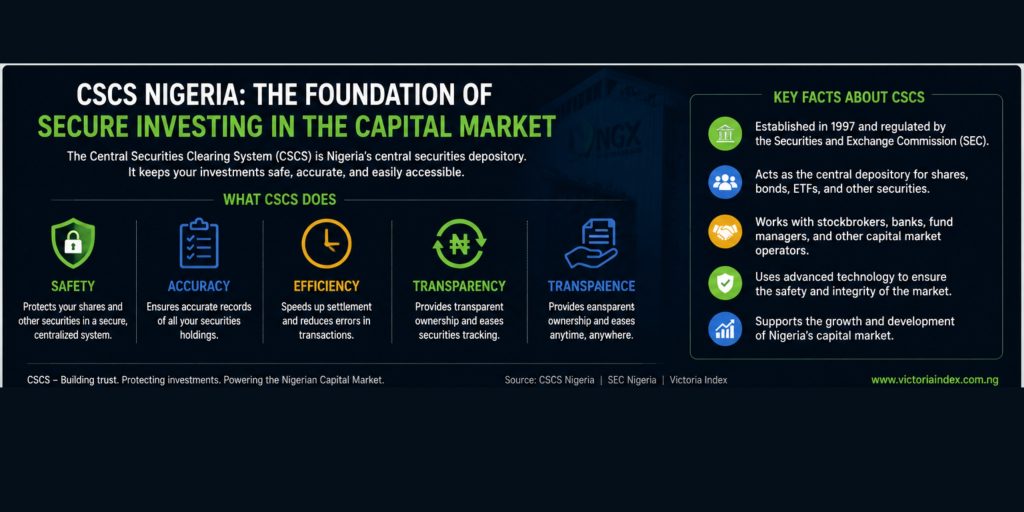
Prior to the development of the electronic depository system that exists today, most share transactions in Nigeria were carried out using physical share certificates. Unfortunately, these documents were prone to damage, loss, and forgery. One of the significant achievements of CSCS Nigeria is the dematerialization of share certificates. This implies that instead of holding physical share certificates, investors hold their shares in electronic form in their CSCS Nigeria accounts. Most novice investors significantly underestimate the importance of dematerialization.
According to this article on CSCS Nigeria and the Nigerian capital market, the system acts as an intermediary between buyers and sellers, authenticating all transactions, ensuring seamless transfer of ownership of the securities, and collecting and disbursing all payments to the rightful owners. In short, CSCS Nigeria plays a critical role in ensuring that every transaction executed by an investor is cleared and settled efficiently and legally.
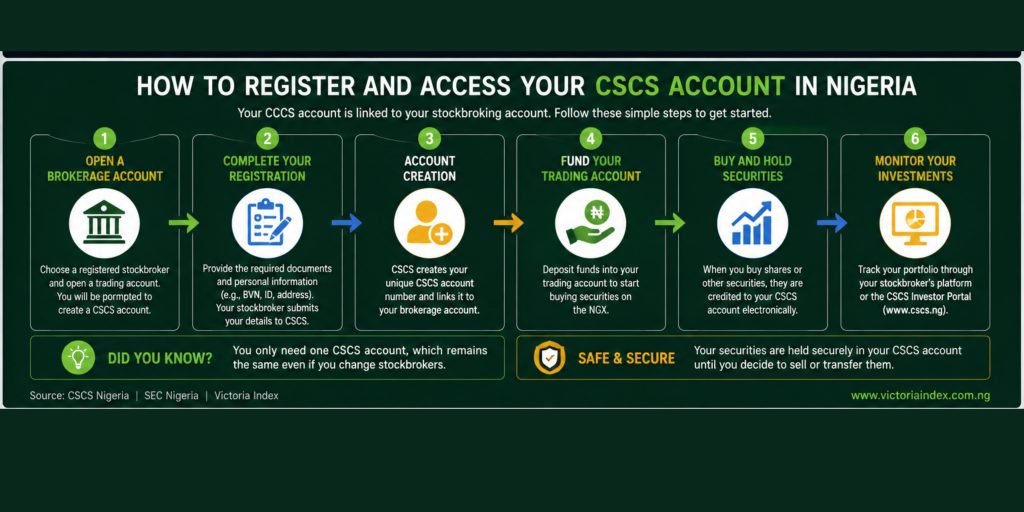
Every investor needs to obtain a CSCS number, also referred to as Clearing House Number or CHN. This CSCS number is necessary for every investor who wishes to own Nigerian stocks. The good news is that getting a CSCS number is relatively straightforward, although new investors might find it confusing at first. According to this informative article on how to get a CSCS number from Trove Finance, one does not apply directly to CSCS Nigeria. Instead, an investor selects a preferred stockbroker or investment app, opens an account with their chosen investment platform, and completes the KYC procedures.
Upon submission of the application, the investment platform submits the application to CSCS Nigeria on the investor’s behalf. Most new investors receive their CSCS number via email or short message service within a few business days of applying. If a beginner cannot recall their CSCS number, they can get it by contacting CSCS Nigeria directly, contacting their preferred stockbroker or investment app, or checking their CSCS e-statements if they have enabled electronic statements.
When You Trade, CSCS Nigeria enables the seamless clearing and settlement of all share transactions in the Nigerian capital market. In short, every trade that takes place on the Nigerian Exchange or over-the-counter markets such as NASD and FMDQ goes through CSCS Nigeria for authorization, confirmation, and settlement. In other words, CSCS Nigeria authenticates each trade, transfers the shares from the seller’s account to the buyer’s account, and facilitates the transfer of funds from the buyer’s account to the seller’s account.
This crucial infrastructure also enables the seamless processing of corporate actions in Nigeria. Processing corporate actions might be a relatively unfamiliar concept to most novice investors. However, most corporate actions such as dividends, bonus issues, and rights issues take place through CSCS Nigeria. This implies that all corporate actions in Nigeria take place seamlessly through the clearing system, and investors who understand this process can benefit tremendously. As a result, CSCS Nigeria has an excellent reputation for being a reliable, credible, and trustworthy stock trading infrastructure.
Most investors would be surprised to learn that CSCS Nigeria has a credit rating, and this score significantly impacts every investor who uses its services. According to this press release from CSCS Nigeria portal, Thomas Murray, a specialist custody ratings agency, upgraded the Central Securities Depository rating from A minus to A, signifying that the firm has a low overall risk. More recently, CSCS Nigeria boasts of having an even better rating, which is A plus. As a result, the firm is today among the highest-rated financial service providers in Africa.
As a beginner, it is essential to highlight the significance of CSCS Nigeria’s credit rating. Essentially, this information aims to demonstrate that CSCS Nigeria is a credible, reliable, and trustworthy market infrastructure with extensive global recognition. As a result, the system has a proven track record of minimizing risk to levels that are considered acceptable by a leading third-party credit rating agency.
Most novice investors are not familiar with the CSCS Nigeria fee schedule, and for good reason. According to this eye-opening report by Nairametrics, CSCS Nigeria made several significant changes to its fee structure in 2026. In short, the organization transitioned from a flat-fee schedule to a value-based one. This implies that instead of every transaction having a fixed fee, the charges are incurred based on the value of the transaction and an investor’s portfolio size, depending on whether one is an institutional or retail investor.
This change primarily affects the fixed income or debt securities space, and beginner investors should consider these changes when deciding how frequently to trade. This information on CSCS Nigeria fees is crucial to most individual investors. Most guides focus primarily on CSCS Nigeria and its importance in the capital market while failing to discuss the fees associated with using its services. In my opinion, it is essential for every novice investor to have a solid comprehension of the CSCS Nigeria fee schedule, including the significant changes that took place in 2026, in order to achieve long-term investment success.
Everyday Nigerian investors benefit directly and indirectly from CSCS Nigeria. Every time an investor receives a dividend from their shares, their trade clears seamlessly, or their corporate actions are processed correctly, everything is facilitated by CSCS Nigeria. Most beginner investors are focused on which stocks to buy while neglecting the other aspects of the investment journey. Every novice investor should be aware of how the Nigerian capital market works to ensure they take advantage of every opportunity to maximize their investment returns.
Based on my interactions with novice investors, there are several CSCS Nigeria-related mistakes that most new investors tend to make. First and foremost, most new investors lose their CSCS number or forget it. As a result, it is crucial for every beginner to save their CSCS number somewhere secure after obtaining it. One of the most common mistakes made by first-time investors is to forget or misplace their number when dealing with multiple investment platforms.
Another frequent error made by first-time investors is to assume that once they purchase shares, nothing else occurs. In truth, it is critical for investors to keep track of all corporate actions processed through CSCS Nigeria since most investors receive their dividends and other benefits through the system. New investors tend to overlook the importance of CSCS Nigeria fees. Understanding how CSCS Nigeria works and what the system charges can help beginner investors maximize their investment returns.
I hope this beginner’s guide to CSCS Nigeria has been eye-opening for the average Nigerian investor. From dematerialization of share certificates to processing corporate actions and receiving dividends, every investor knows that the Nigerian capital market would not be operational without CSCS Nigeria. In addition, the reputable clearing system has risk ratings that are considered attractive by most investors. The next time a novice investor checks their portfolio and sees their shares, they will be aware of the financial infrastructure that makes their investment gains possible and enable them to grow exponentially. In short, every Nigerian investor would be wise to take the time to learn everything they can about CSCS Nigeria.