Physical Address
Victory Est, Ogombo Ajah, Eti-Osa, Lekki 101245, Lagos
Physical Address
Victory Est, Ogombo Ajah, Eti-Osa, Lekki 101245, Lagos

Nigeria Financial News, Stock Market Data, Economy & Market Analysis
Nigeria Financial News, Stock Market Data, Economy & Market Analysis
Without further ado, let us delve straight into an examination of the profiles of Nigeria’s most influential CEOs, who represent the dynamic nexus of contemporary corporate governance in the Nigerian business landscape. From the bustling heart of Lagos, where the most progressive organizations reside, to the strategic epicenter of Abuja, where shrewd business leaders negotiate deals worth billions of Naira, influential businessmen shape a new narrative of African progress.
A sustainable empire can never be established without capital, but also it needs some special qualities that can only belong to exceptional people. Observing the dynamics of the business world with great interest, I can testify that these special CEOs have managed to turn macroeconomic problems into tremendous possibilities. Now let us focus on discovering the secrets of these corporate masters, as well as studying their strategies and philosophy.

There is no way you can discuss the profiles of the most influential CEOs in Nigeria without first mentioning the name of Alhaji Aliko Dangote. Being the President and CEO of the Dangote Group, he has diversified interests in areas such as cement manufacturing, sugar production, oil, and petrochemicals.
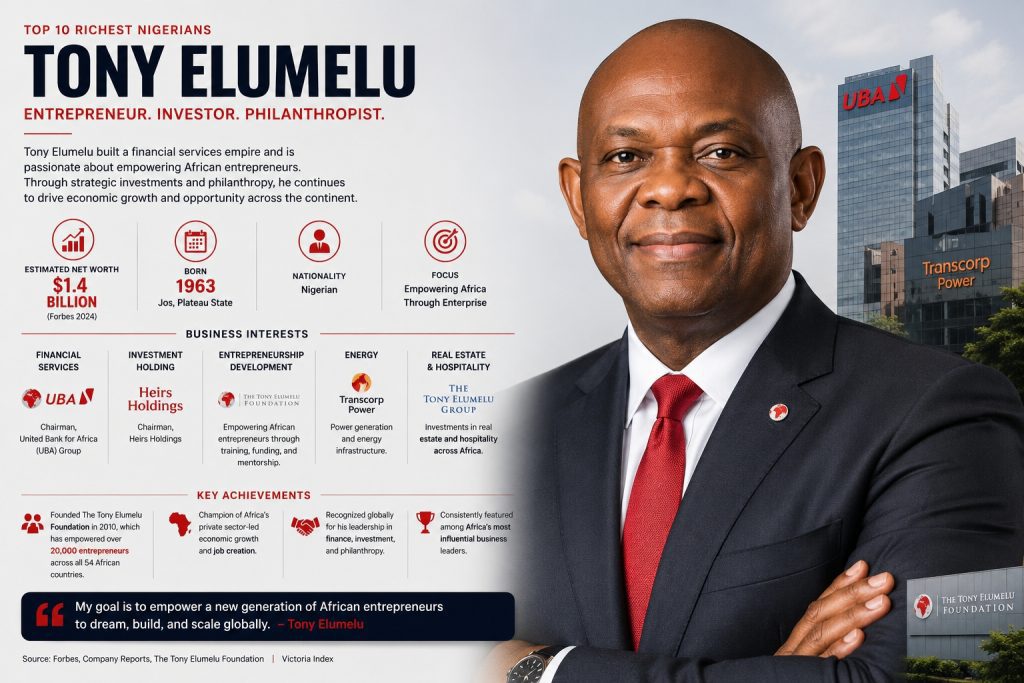
Another exceptional leader who continuously redefines corporate leadership is Tony Elumelu, the Chairman of Heirs Holdings and United Bank for Africa (UBA). Through his investment philosophy, which he calls “Africapitalism,” Elumelu argues that the African private sector can, and must, be the primary driver of the continent’s economic transformation.
Another exceptional leader who continuously redefines corporate leadership is Tony Elumelu, the Chairman of Heirs Holdings and United Bank for Africa (UBA). Through his investment philosophy, which he calls “Africapitalism,” Elumelu argues that the African private sector can, and must, be the primary driver of the continent’s economic transformation.
It is amazing the way he applies both strategies of making an impact. On the one hand, he manages a huge financial services network that connects businesses from over twenty countries in Africa. However, on the other hand, through his foundation, he encourages and supports thousands of startups each year. In the analysis of the profiles of the Nigerian Most Influential CEOs, Elumelu is notable because of the successful combination made by him as a leader between big profits and socio-economic development.
In an organization that has always been male-dominated, Omogiafo Owen of Transnational Corporation Plc (Transcorp), who is the president and group CEO, sets an excellent example of organizational management skills. Transcorp is one of the most diversified conglomerates we have in Nigeria, with vast interests in power production, hospitality industry, and oil & gas industries.
The management of such a diverse portfolio calls for high levels of efficiency and effectiveness. It is impressive to follow how Omogiafo manages to ensure efficient power production to overcome our country’s energy gap while at the same time ensuring best practices in the hospitality industry. These are some of the reasons why she continues to be recognized as one of the most influential CEOs in Nigeria.
If one wants to comprehend the larger organizational context through which an individual such as Omogiafo acts, then one should investigate the corporate governance principles put forward by the Financial Reporting Council of Nigeria.
There cannot be a full Nigerian success story without talking about the country’s thriving technological community. This includes entrepreneurs like Olugbenga “GB” Agboola, the co-founder and CEO of Flutterwave, who is transforming the interaction between the world and Africa through innovation.
Agboola has played a critical role in helping overcome the problem of fragmented payment infrastructure in Africa. Through his initiative that brings together local bank accounts, mobile wallets, and international card networks, Agboola has created enormous economic value. The profiles of Nigeria’s Top Influential CEOs highlight the transition towards digitalization led by Agboola. Agboola’s experience is very important for tech entrepreneurs in Nigeria who need to expand their digital solutions to international markets while remaining true to their local identity.
While tech start-ups are only gaining momentum in West Africa, Funke Opeke saw the future and made substantial investments into infrastructure development. As the founder and former CEO of MainOne, Opeke implemented the project involving the installation of 7,000 kilometers of subsea fiber optic cables between West Africa and Europe.
In my conversations, I always emphasize how today’s digital revolutions would have been impossible were it not for the strong infrastructures built through the vision of great minds such as Opeke. She was able to combine her engineering knowledge with astute business acumen to give internet connections to hundreds of companies through MainOne, which she then sold to the global leader in digital infrastructures, Equinix. Analyzing the profiles of Nigeria’s most influential CEOs, Opeke comes across as an audacious trailblazer who invested his money in building the infrastructure of today’s digital world.
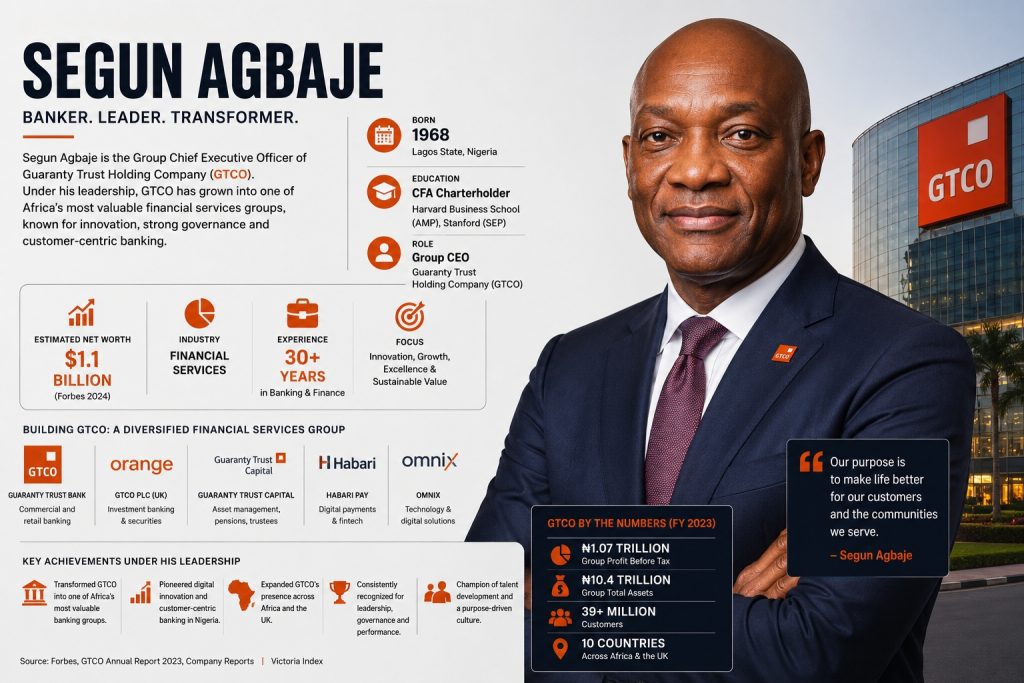
Over the past decade, there have been many disruptions within the banking sector. The Group Chief Executive Officer of the Guaranty Trust Holding Company (GTCO) has been a key player in transforming his bank. This is because under him, GTBank transformed from just a regular bank into a holistic financial services holding company.
Agbaje realized very early that banks are not only competing with other banks but with fintech platforms. Through concentrating on retail banking, friendly mobile apps, and lifestyle platforms such as Habari, Agbaje made sure GTCO remained market dominant. This foresight on his part makes him deserve the place in the profile of Nigeria’s Most Influential CEOs. It is an amazing case study for influential businessmen in Lagos trying to maintain their market share amidst digital competition.
It should be observed that when the above case studies are carefully considered, it is clear that certain operational characteristics define the performance of these CEOs amidst changing macroeconomics.
High Risk Tolerance: They do not wait for the perfect economic environment; they build through the storms.
Deep Local Knowledge: They understand consumer behavior, regulatory frameworks, and infrastructural realities better than any external consultant.
Talent Development: They place high value on building exceptional management teams to execute their long-term visions.
For individuals who follow the trends concerning corporate expansions and public sector partnerships, keeping track of the projects of the Nigerian Investment Promotion Commission becomes a must-have. This is usually where the key players in Abuja link their corporate expansions with the national economics.
The analysis of the profiles of Nigeria’s most influential CEOs shows that effective management in business is not about maximizing profits at all costs but rather about creating sustainable environments, creating mass employment opportunities, and contributing to the creation of a proud nation. Regardless of whether we are talking about the successes of tech entrepreneurs in Nigeria who develop unique software or industrial leaders who produce important products, these personalities prove that there is no limit to our economy’s potential.
Looking into the future, it is clear that the methods applied by these highly experienced businessmen in Nigeria can become the best textbook for the emerging generation of entrepreneurs. Let’s see what innovations our business community offers us now, and let’s be sure that they will bring transformation to all of Africa on the international stage!