Physical Address
Victory Est, Ogombo Ajah, Eti-Osa, Lekki 101245, Lagos
Physical Address
Victory Est, Ogombo Ajah, Eti-Osa, Lekki 101245, Lagos

Nigeria Financial News, Stock Market Data, Economy & Market Analysis
Nigeria Financial News, Stock Market Data, Economy & Market Analysis

At times, it becomes difficult to envisage whether there really are hidden financial risks facing Nigerian banks even in the context of 2026. Our domestic banking system is currently giving out an illusion of being invincible. Passing by the impressive glass skyscrapers belonging to our top banks, or going through the daily reports of our financial news agencies as they cover the end of the CBN recapitalization process, one can be easily convinced that our financial establishments have become totally invulnerable. We are witnessing emerging issues, which require immediate action. Hidden financial risks of Nigerian banks are developing silently but threaten to impact the economy as a whole.
Despite the celebration of the successful accomplishment of dozens of commercial organizations to meet the required paid-up capital threshold, important changes are taking place behind the scenes. The extra profits, earned by our local banks due to severe currency devaluation, will no longer provide an additional source of income.
Indeed, for corporations, retail investors, and business managers, being aware of the actual state of affairs with respect to these loan portfolios will be critical towards safeguarding one’s wealth.
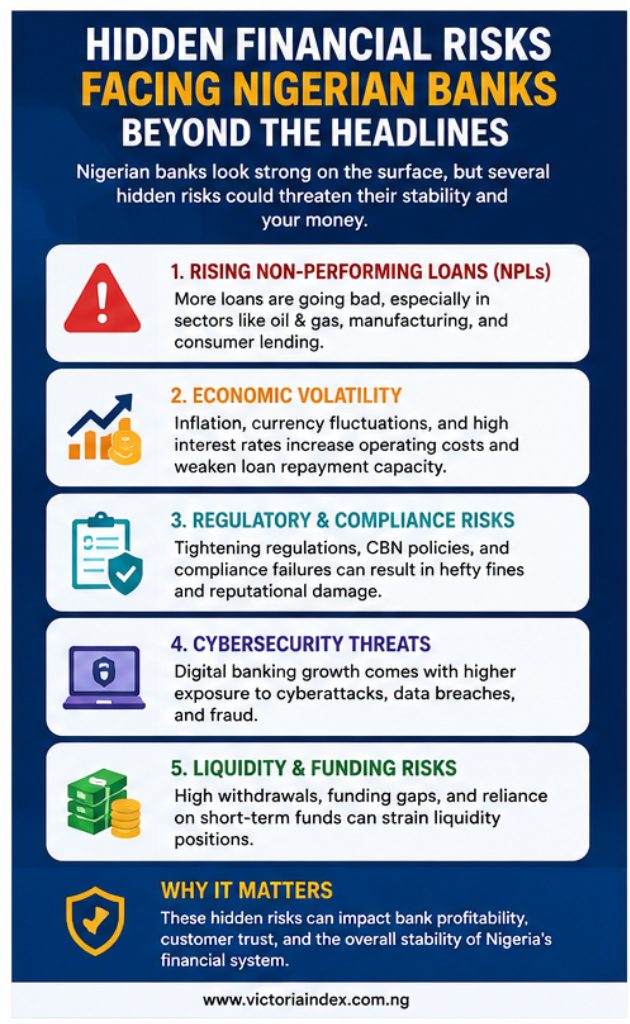
We start with addressing the greatest threat facing financial institutions today. Over the past few years, regulatory buffers have been available allowing local banks to adjust troubled credit portfolios while still maintaining the portfolio status quo, meaning NPL designation was avoided, and hence, balance sheets were immaculate. However, such a buffer no longer exists.
In a recent announcement made by the banking sector regulator, the national bad debt ratio has risen dramatically, reaching levels beyond the 5% tolerance of the apex bank. And this trend is definitely not coincidental; it has been caused by the end of CBN’s temporary credit forbearance and single obligor limit waivers.
Now, when we remove such a buffer, the effects of rising interest rates and exchange rate instability on corporates become immediately evident. Industrial plants, fleet carriers, and import-dependent conglomerates are having severe difficulties meeting their payments due to rising interest rates and exchange rates, which are currently taking place during the monetary tightening period.
With regard to the financial weaknesses we identify as part of our team of researchers at VictoriaIndex Limited in monitoring company data, we have identified different regional trends within the areas.
Within the administrative regions, there are immense amounts of pressures being applied by the boardroom executives of Abuja. In addition, the apex bank in Nigeria has recently required all banks to conduct stress tests on the entirety of the financial industry. The compliance teams are currently working tirelessly to ensure that the risk management governance framework will be able to withstand the enormous inflows of public offer capitals without experiencing any kind of systemic breakdowns.
With regard to the primary commercial region, the financial analysts within Lagos are observing the overnight liquidity corridors carefully. Currently, the banks are maintaining an extraordinary amount of excess cash and frequently utilizing the CBN Standing Deposit Facility window in order to receive risk-free yields. However, such reliance on the central bank rather than utilizing credits in the real economy is a risky asset-liability management problem.
Meanwhile, brief assignments involving debt collection, asset seizure, and credit restructuring among others have increased immensely amongst large law firms in Ibadan State of Oyo. Corporate borrowers who had failed to meet their financial obligations are being targeted heavily through litigation to allow lenders to streamline their books before the end of each quarter.
In the northern part of the country, the consequences of corporate liquidity restrictions on commercial banks are now being felt greatly by micro-finance banks located in Kano and nearby agricultural commercial centers. Once commercial banks decide to limit their credit facilities to large scale off takers due to NPLs, informal lending facilities for smaller players becomes extremely tough.
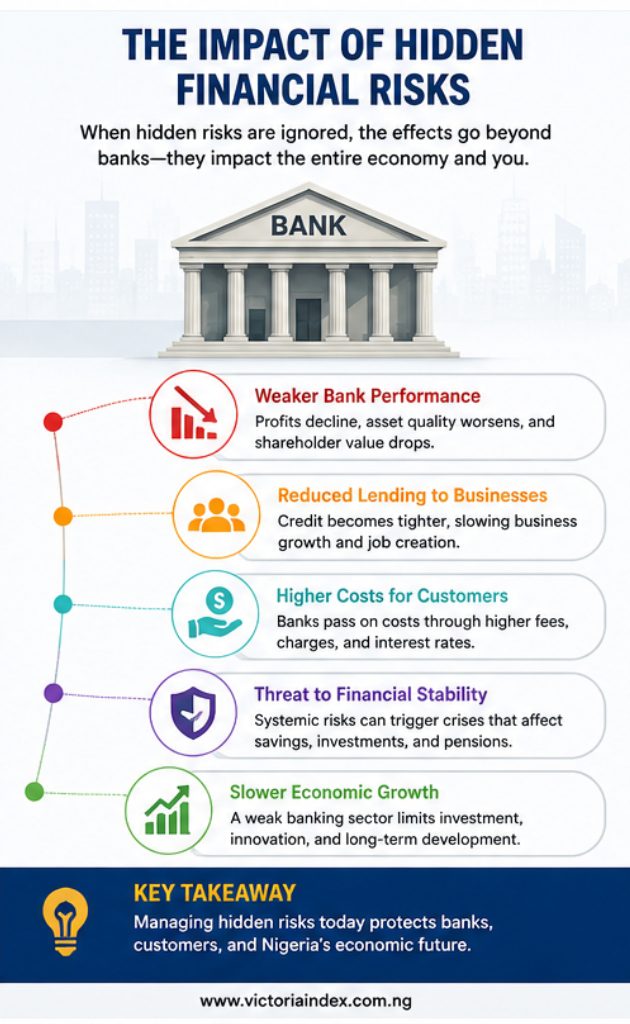
Another blind spot is one that has not been fully appreciated yet. To comply with the multi billion naira requirement set for recapitalization, a lot of merging and acquisition processes occurred within the financial system. Although the intention to combine two or more weak institutions into one seems like a solution on paper, there is great risk involved.
A banking merger goes beyond a mere merger of financial ledgers. It is the complicated marriage of differing technology infrastructures, opposing corporate cultures, and divergent credit policies. If done too quickly, operational holes will become apparent to the extent that there could be catastrophic failures.
When banks are forced into merging by regulatory deadlines, there is always a great deal of internal resistance involved. Incompatible legacy computer systems may lead to accounting mishaps, data delays, and loss of transaction tracking capabilities.
In addition, according to structural risk governance lessons highlighted on the, failure to audit the legacy portfolio of loans during a bank acquisition could lead to the unintended consequence of having a healthy bank take on toxic assets, thus negating all of their efforts in building up their new capital.
It is impossible to speak about the unseen threats to the finances of the banks in Nigeria without discussing the threat from the cyber world. Though the move towards digital banking apps has helped greatly increase financial inclusion, it has equally created broad entry channels for the sophisticated cyber syndicates.
The amount lost through digital fraud is increasing at an exponential pace. In order to arrest this worrying trend, the Central Bank of Nigeria issued a stringent requirement that institutions must reduce their time to respond to and stop fraudulent transactions to less than half an hour. This would require the deployment of considerable capital into artificial intelligence software and cybersecurity specialists, increasing overall cost of operations amidst reduced revenue streams.
In order to keep your money safe from this systemic challenge, I urge you strongly to adopt a stringent financial safety protocol grounded in the following three principles:
Avoid selecting a bank just because it has a great marketing program or an easy mobile application. Go ahead and review its official balance sheet reports. Focus on their liquidity coverage ratios, tier-one capital adequacy ratios, and unique NPL trajectories. Keep your company’s core financial cash flows with banks that have clear credit portfolios.
Before you engage in a prolonged finance transaction or custodian arrangement with any financial institute, always crosscheck the sanction logs on their compliance page at the official website. Make sure that your chosen institution does not carry any pending sanctions, dividend suspensions, or exceed any single obligor limits.
Don’t put all your money into one financial institution. Rather keep your liquidity diversified into various banking channels. You can diversify your cash flow by using international commercial banks, financial asset management firms, and treasury accounts. The benefit of such diversification is that even if one institution freezes its liquidity channel for some time, you won’t be affected.
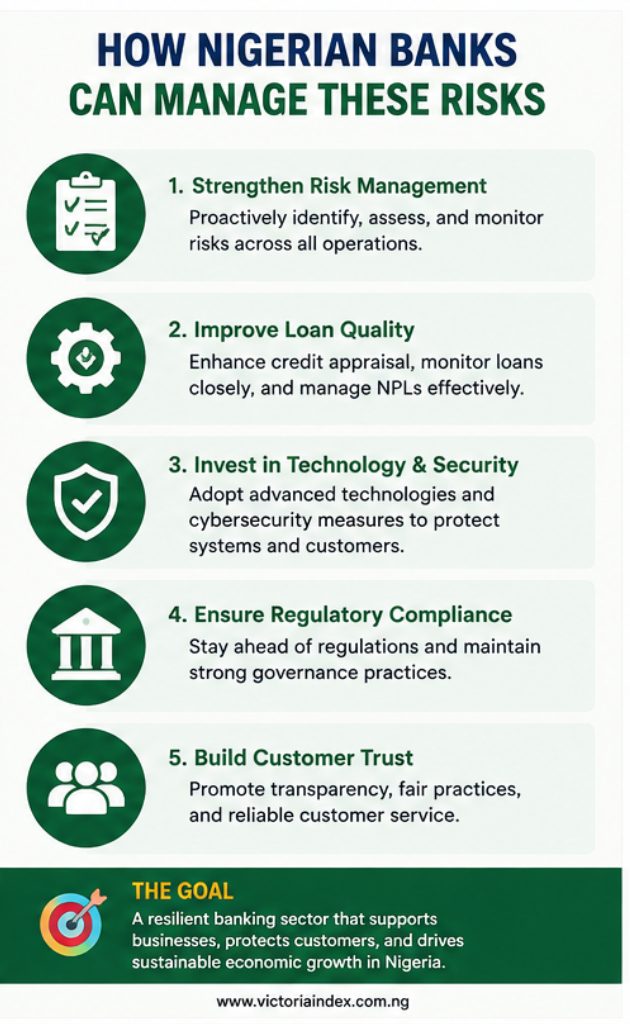
After all, the continuous evolution of our financial system is a much-needed one. Shedding off the artificial mechanisms of forbearance is an unpleasant yet necessary process that, in due course, would compel the banking sector to practice credit discipline.
Through understanding these latent dangers that exist within our banking industry and not ignoring them, wealth creators can adequately plan for their capital investments. This next period shall prove to be one of trial for our financial boardrooms. But through ensuring the safety of our institutions rather than seeking out risky returns, we shall be able to effectively shield ourselves from harm and flourish amidst a better, more stable financial environment.